
Asthma in Children: How Spacers, Schools, and Care Plans Work Together

When a child has asthma, every breath matters. For many kids, a simple plastic tube called a spacer can mean the difference between a normal day at school and an emergency room visit. Yet, despite being one of the most effective tools in pediatric asthma care, spacers are still underused, misunderstood, or forgotten-especially when kids are away from home.
Why Spacers Are Non-Negotiable for Kids
Most children with asthma use a metered-dose inhaler (MDI) to deliver quick-relief medicine like albuterol. But here’s the problem: if the child doesn’t coordinate pressing the inhaler and breathing in at the exact same moment, most of the medicine hits the back of the throat instead of the lungs. That’s not just ineffective-it’s dangerous. Up to 80% of kids using inhalers alone get little to no benefit.
A spacer fixes this. It’s a hollow tube, usually made of plastic or anti-static material, that attaches to the inhaler. When you press the inhaler, the medicine floats inside the spacer like a cloud. The child then breathes in slowly and naturally over four breaths. No timing needed. No coordination required.
Studies show that with a spacer, kids get 73% more medicine into their lungs compared to using the inhaler alone. For children under five, this isn’t just helpful-it’s life-saving. One major study found that using a spacer with an inhaler cut hospital admissions by more than half compared to nebulizers. And it’s cheaper. Emergency visits drop. Hospital stays get shorter. Families save money.
But here’s the catch: spacers only work if they’re used right. And that’s where things fall apart.
How to Use a Spacer Correctly (The 9-Step Rule)
It’s not complicated, but it’s easy to mess up. Here’s what actually works, based on guidelines from the Royal Children’s Hospital and the Global Initiative for Asthma:
- Have your child sit upright-no slouching.
- Shake the inhaler well.
- Insert the inhaler into the back of the spacer.
- Place the mouthpiece in their mouth (or put the mask snugly over nose and mouth for kids under 5).
- Ask them to breathe out gently-not into the spacer.
- Press the inhaler once. Just one puff.
- Have them breathe in and out slowly through their mouth, four times. Count it out: “One… two… three… four.”
- Wait 30 seconds before giving a second puff, if needed.
- Wash the spacer weekly with dish soap, rinse lightly, then air-dry without wiping. Never dry it with a towel-that creates static and traps medicine.
Static electricity is the silent killer of spacer effectiveness. If you wipe the spacer dry, it builds up a charge that grabs the medicine like a magnet. That’s why you don’t wipe it. Just let it air-dry. And always keep a spare spacer on hand. If the one you’re using gets wet, it won’t work. Period.
Why Schools Are the Missing Link
Most kids with asthma spend more time at school than at home. Yet, too many schools don’t have a plan for managing asthma attacks. In 2022, 6.2 million U.S. children had asthma. That’s one in 12. In New Zealand, the numbers are similar. But only 42 states in the U.S. legally require schools to keep asthma medication on-site. And even then, many schools don’t have spacers readily available.
Why? Because spacers are bulky. They’re not like an EpiPen that fits in a pocket. A standard spacer is about 15 cm long. Teens hate carrying them. One 14-year-old told a nurse, “It makes me look like I’m sick.” So they leave it at home. Or worse-they forget it after PE.
And teachers? Most have never been trained. A 2022 study found that 78% of school staff couldn’t demonstrate correct spacer use. That’s not their fault-they’ve never been shown how.
But schools that do it right see results. One school district in Auckland started keeping spacers in every nurse’s office, trained all staff in 15-minute sessions, and gave every student with asthma a personalized care plan. Within a year, asthma-related absences dropped by 37%. Kids didn’t miss school. They didn’t end up in the ER. They just… got to be kids.

What a Good Asthma Care Plan Includes
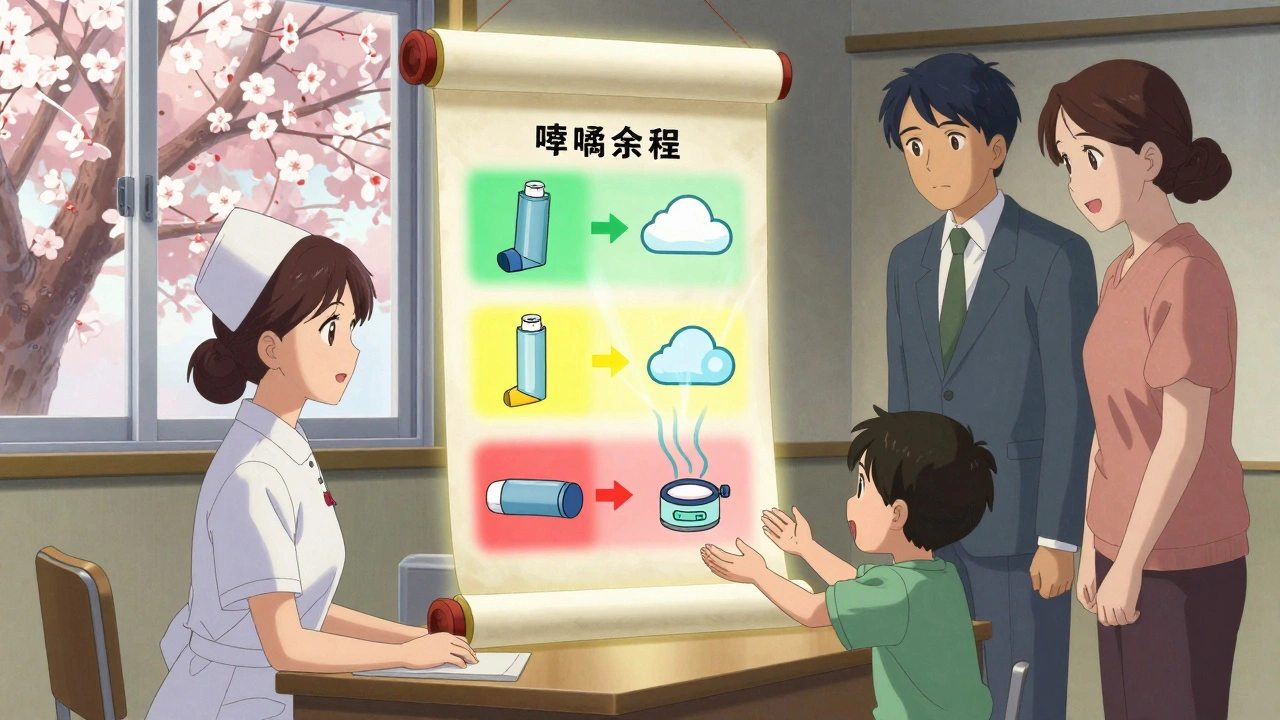
A care plan isn’t just a piece of paper. It’s a living document that tells everyone-parents, teachers, school nurses, coaches-what to do when symptoms flare up. The best ones follow a simple color-coded system:
- Green zone: No symptoms. Normal activity. Use preventer inhaler daily as prescribed.
- Yellow zone: Coughing, wheezing, or shortness of breath. Use reliever inhaler with spacer, rest, monitor. Call parent if no improvement in 20 minutes.
- Red zone: Struggling to breathe, lips turning blue, unable to speak in full sentences. Use spacer + inhaler immediately. Call emergency services.
The plan must list:
- Which inhalers the child uses (name, dose, frequency)
- Whether they use a spacer (and if so, which one)
- Who to contact in an emergency
- Any triggers to avoid (like pollen, smoke, or cold air)
- When to go to the doctor
And here’s the key: the plan needs to be signed by the child’s doctor and shared with the school. Not just filed away. Posted where the nurse can see it. Given to PE teachers. Carried by the child if they’re old enough.
The Teenage Problem: Why Technique Falls Apart
Younger kids-ages 4 to 8-usually follow instructions well. They like the mask. They think the spacer is cool. But around age 10, things change. Teens want to fit in. They don’t want to be the kid who always stops to use their inhaler. They skip doses. They forget their spacer. They use the inhaler alone.
Research shows adolescents are 80% less likely to use their inhaler correctly than younger children. Even when they have a spacer, they rush. They press the inhaler twice. They breathe too fast. They don’t wait between puffs.
What works? Peer support. One school in Wellington started a student asthma ambassador program. Kids trained in spacer use helped teach others. Suddenly, using a spacer wasn’t embarrassing-it was normal. The school saw a 60% drop in inhaler misuse over six months.
Another trick: smaller, foldable spacers. Newer models are now designed to snap into a keychain or fit in a pencil case. They’re not as big as the old ones. And they work just as well.
What’s Changing in 2025
The tide is turning. In early 2024, the American Academy of Pediatrics updated its guidelines to say: “All school staff should receive basic spacer training.” The CDC is now funding programs to distribute free spacers to schools in low-income areas. And a new $2.5 million NIH study is testing smartphone apps that use video to check if kids are using their spacers right.
One app lets a parent or nurse record a 10-second video of the child using the spacer. The app analyzes the motion-did they press once? Did they breathe slowly? Did they wait between puffs? It gives instant feedback. Early results show technique improves by 40% in just two weeks.
These aren’t sci-fi ideas. They’re practical, affordable, and already being tested in real classrooms.
What Parents Can Do Right Now
You don’t need to wait for a policy change. Here’s what you can do today:
- Ask your child’s doctor for a written asthma care plan. Don’t take “we’ll email it” as an answer. Get it printed and signed.
- Visit the school nurse. Bring the plan. Bring the spacer. Show them how to use it.
- Ask if the school keeps spare spacers on hand. If not, donate one. A $15 device could save a life.
- Practice with your child every week. Make it a routine, like brushing teeth.
- Check the spacer weekly. Wash it. Let it dry. Replace it if it cracks or turns cloudy.
And if your child is a teen? Don’t lecture. Ask them. “What’s the hardest part about using your spacer at school?” Listen. Then help them solve it. Maybe they need a smaller one. Maybe they need a case. Maybe they just need to know they’re not alone.
Final Thought: It’s Not About the Device. It’s About the System.
A spacer is just a piece of plastic. But when it’s part of a system-trained staff, clear plans, consistent practice, and open communication-it becomes a lifeline. Asthma doesn’t stop when the school bell rings. And care shouldn’t either.
Can my child use an inhaler without a spacer?
For children under 12, using an inhaler without a spacer is not recommended. Most of the medicine ends up in the mouth or throat, not the lungs. This reduces effectiveness and increases side effects like hoarseness or thrush. Even older kids benefit from spacers-especially during an asthma flare-up. Always use a spacer with a reliever inhaler unless a doctor says otherwise.
How often should I clean my child’s spacer?
Wash the spacer once a week with warm water and a drop of dish soap. Don’t rinse it out completely-just let it air-dry. Rinsing removes the soap residue that prevents static buildup. Static traps medicine, so skipping this step makes the spacer less effective. Never wipe it with a towel or cloth.
What if my child refuses to use the spacer at school?
Talk to the school nurse and teacher. Ask if they can let your child keep a spare spacer in their backpack or locker. Some newer spacers are small enough to fit in a pencil case. You can also ask if the school has a discreet storage spot for medications. Peer support helps-many teens feel better using a spacer once they see others doing it too.
Are spacers covered by insurance?
In most cases, yes. Spacers are considered medical equipment and are typically covered under prescription drug plans. In New Zealand, they’re available free through the public health system with a prescription. In the U.S., most insurance plans cover them under durable medical equipment. If you’re denied, ask for a letter of medical necessity from your child’s doctor.
Can a spacer be used with a preventer inhaler?
Yes. Preventer inhalers (like fluticasone or budesonide) should always be used with a spacer, especially in children. This reduces the risk of oral thrush and ensures the medicine reaches the airways where it’s needed. Always rinse the child’s mouth with water after using a preventer inhaler, even with a spacer.
What should the school do if my child has an asthma attack?
The school should follow the asthma care plan. That means giving the reliever inhaler with spacer immediately, letting the child rest, and monitoring symptoms. If there’s no improvement after four puffs (with 30-second breaks), or if the child is struggling to breathe, they should call emergency services. Staff should never wait to see if it gets better. Asthma attacks can worsen quickly.
Courtney Black
December 10, 2025 AT 06:29Spacers are the unsung heroes of pediatric asthma care. Nobody talks about them because they’re not flashy like nebulizers or smart inhalers. But if you actually understand how much medicine gets wasted without one, it’s terrifying. 80% loss? That’s not a margin-that’s a failure of system design. We treat asthma like it’s a minor inconvenience when it’s literally a matter of life or death for kids who can’t articulate their breathing struggles. And yet we let schools skip training because it’s ‘too much work.’
It’s not about the device. It’s about who we decide is worth protecting.
iswarya bala
December 10, 2025 AT 12:06omg this is so true!! my lil bro uses a spacer and i never knew how much it helped 😭 we used to just give him the inhaler and he’d cough for 10 mins… now he just breathes in and out and its like magic. schools need to get it together!!
Simran Chettiar
December 11, 2025 AT 22:08It is an undeniable fact, grounded in empirical clinical evidence and supported by international pediatric respiratory guidelines, that the utilization of spacer devices in conjunction with metered-dose inhalers significantly enhances pulmonary deposition of corticosteroids and beta-agonists in pediatric populations. The failure of educational institutions to institutionalize spacer protocols reflects not merely negligence, but a systemic devaluation of respiratory health as a non-negotiable component of child welfare. One must question the moral calculus of a society that prioritizes bureaucratic convenience over the physiological integrity of its youngest members.
Richard Eite
December 12, 2025 AT 00:21USA has the best healthcare in the world so why are we even talking about this? If your kid can’t breathe, take them to the ER. Problem solved. Schools shouldn’t be medical clinics. Also spacers are for wimps. Just teach kids to breathe right. We didn’t have spacers in the 80s and we turned out fine.
Katherine Chan
December 12, 2025 AT 19:33This is the kind of post that makes me believe change is possible. I work in a school district and we just started keeping spacers in every nurse’s office last year. One kid told me, ‘I didn’t know I could breathe like this.’ That’s all you need to hear. We’re not fixing a system-we’re giving kids back their childhoods. And it starts with a $15 plastic tube. I’m donating 10 more today.
Philippa Barraclough
December 14, 2025 AT 19:27While the efficacy of spacers is well-documented, I’m curious about the long-term adherence patterns among adolescents. The data on usage drop-off around age 10 is alarming, but are there longitudinal studies tracking whether this non-adherence correlates with increased asthma severity in adulthood? Furthermore, the cultural stigma associated with visible medical devices in school settings-particularly in Western societies-deserves deeper anthropological analysis. Is the resistance purely about appearance, or is it tied to broader identity formation during puberty? The mention of peer-led programs is promising, but how scalable are they across socioeconomic strata?
Tim Tinh
December 16, 2025 AT 03:40my cousin’s kid uses a spacer and i never realized how big the difference was. i thought it was just a fancy tube but turns out it’s like a secret weapon. my sister got one of those keychain ones and now he carries it everywhere. he even showed his friends how it works and now they all want one 😄 schools need to stop acting like this is optional. it’s not a luxury, it’s a basic tool.
Olivia Portier
December 16, 2025 AT 13:38I’m a school nurse in Manchester and we’ve had the same spacer program since 2021. Every kid with asthma gets a personalized plan, a spacer, and a little sticker on their locker that says ‘I breathe easy here.’ It’s small but it changes everything. No more hiding. No more shame. We trained every teacher-even the PE ones. And guess what? No more emergency calls during dodgeball. We’re not just managing asthma-we’re normalizing it. And that’s powerful.
Tiffany Sowby
December 17, 2025 AT 21:36Ugh. Another ‘we need to fix everything’ post. My kid has asthma and we manage fine. Why should the school have to babysit? The parents should be responsible. And why are we giving out free spacers to low-income areas? That’s just encouraging dependency. If you can’t afford medicine, maybe don’t have kids. Also, who let this article get so long? I stopped reading after the third paragraph.
Guylaine Lapointe
December 18, 2025 AT 02:28It is morally indefensible that a child’s access to basic, life-sustaining medical equipment is contingent upon the whims of local school budgets and the willingness of overworked nurses to advocate for it. The fact that this is even a debate in 2025 reveals a profound failure of public health policy. Spacers are not ‘nice to have.’ They are a medical necessity on par with insulin for diabetics. To treat them as optional is to institutionalize preventable suffering. The real tragedy is not the lack of spacers-it’s the lack of outrage.
Andrea Beilstein
December 19, 2025 AT 13:14What’s interesting is how the spacer becomes a metaphor for care itself-something simple, invisible, easily ignored, yet absolutely essential when things fall apart. We build systems around complexity-apps, algorithms, smart devices-but the real breakthroughs are always the quiet ones. A plastic tube. A breath. A teacher who knows to wait 30 seconds. Maybe the future of medicine isn’t in AI-it’s in remembering to wash the spacer and let it air dry.
Lisa Whitesel
December 19, 2025 AT 19:03This whole thing is a scam. Spacers don’t work better. It’s just pharma pushing more devices. Nebulizers are fine. And why are we giving kids masks? They look ridiculous. Also, who says you can’t wipe a spacer? I wipe mine with a paper towel every day. No problem. This article is just fear-mongering to sell more plastic.
Larry Lieberman
December 20, 2025 AT 09:16Just watched a video of a kid using a spacer with the new app that analyzes breathing 🤯 it told him he was breathing too fast and gave him a 🎯 emoji when he got it right. He did a happy dance. This is the future. We’re turning asthma management into a game. Kids are winning. Schools are winning. Parents are crying. This is what progress looks like.
Sabrina Thurn
December 21, 2025 AT 04:58From a clinical perspective, the spacer’s role in reducing oropharyngeal deposition of corticosteroids is critical in mitigating the risk of oral candidiasis and dysphonia. The 73% increase in lung deposition aligns with pharmacokinetic modeling from the 2020 Cochrane review on MDI-spacer efficacy in children under 12. However, the real barrier isn’t efficacy-it’s implementation fidelity. Even in high-resource settings, adherence to the 9-step protocol drops below 40% without structured training. The key intervention isn’t device distribution-it’s competency-based education for caregivers and school personnel. Without it, the spacer becomes a prop, not a tool.