
Breastfeeding and Medications: What You Need to Know About Drug Transfer Through Breast Milk

Breastfeeding Medication Safety Checker
Check if your medication is safe to take while breastfeeding using the L1-L5 safety scale. This tool provides information based on the most current research and the breastfeeding safety scale developed by Dr. Thomas Hale.
When you’re breastfeeding, every pill, injection, or patch you take doesn’t just affect you-it can reach your baby. It’s a reality that worries many new parents. Drug transfer through breast milk sounds scary, but the truth is simpler than most think. Most medications are safe. Fewer than 2% of breastfed infants experience any real side effects from what passes through milk. The real challenge isn’t avoiding medicine-it’s knowing which ones are safe, when to take them, and where to find trustworthy answers.
How Medications Get Into Breast Milk
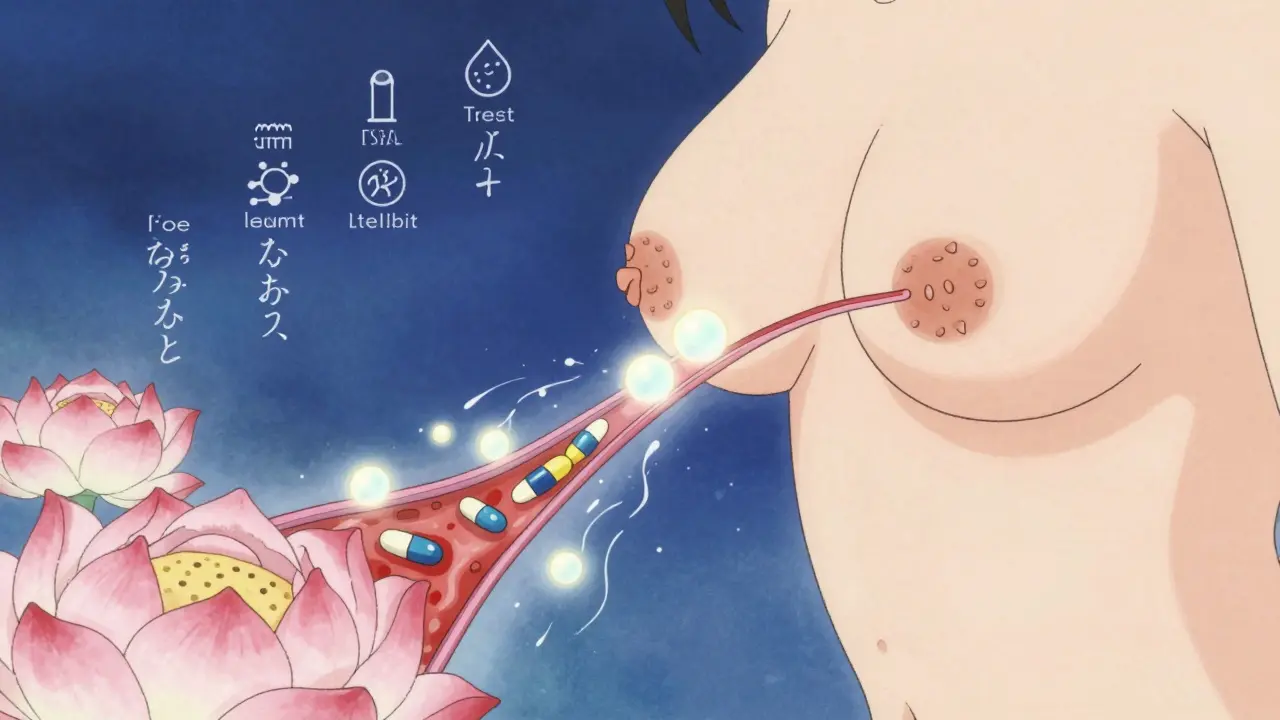
Medications don’t magically appear in breast milk. They travel from your bloodstream into your milk through a natural process called passive diffusion. Think of it like water seeping through a sponge. The drug molecules move from where they’re more concentrated (your blood) to where they’re less concentrated (your milk). This isn’t random-it follows clear rules.Four key factors decide how much of a drug ends up in your milk:
- Molecular weight: Molecules under 200 daltons slip through easily. Most common drugs-like ibuprofen or amoxicillin-are small enough to pass.
- Lipid solubility: Fatty drugs move more easily into milk. That’s why some antidepressants and sedatives show up in higher amounts.
- Protein binding: If a drug sticks tightly to proteins in your blood (over 90%), it can’t get into milk. Warfarin and many antibiotics fall into this safe zone.
- Half-life: Drugs that stick around in your body for more than 24 hours have more time to build up in milk. Shorter half-life drugs clear faster, reducing exposure.
There’s also something called ion trapping. Breast milk is slightly more acidic than your blood. Weakly basic drugs-like certain antidepressants or lithium-get pulled into milk and stuck there. This can make milk concentrations two to ten times higher than in your blood. But even then, the actual amount your baby absorbs is often tiny.
In the first few days after birth, your milk is colostrum. It’s thick, sticky, and made in small amounts-just 30 to 60 milliliters a day. Even if a drug gets into colostrum, your baby isn’t drinking enough to get a significant dose. By day five, milk volume increases, but your body’s barriers also tighten up. Mammary cells close the gaps that let drugs pass early on. So, while more milk is made, less drug gets through.
The L1-L5 Safety System: What the Numbers Mean
Dr. Thomas Hale created the most trusted system for rating medication safety during breastfeeding: the L1 to L5 scale. It’s not perfect, but it’s the best tool we have.- L1 (Safest): No reported adverse effects in infants. Examples: acetaminophen, ibuprofen, many antibiotics like penicillin and amoxicillin.
- L2 (Probably Safe): Limited data, but no serious side effects seen. Examples: sertraline, citalopram, fluoxetine (though fluoxetine can accumulate).
- L3 (Possibly Safe): Limited data, potential risk. Use with caution. Examples: lithium, certain anticonvulsants like valproic acid.
- L4 (Possibly Hazardous): Evidence of risk, but benefits may outweigh it. Examples: cyclosporine, some chemotherapy drugs.
- L5 (Contraindicated): Proven risk. Avoid completely. Examples: radioactive iodine, chemotherapy agents like methotrexate, ergotamine.
Here’s what matters: L1 and L2 drugs make up the vast majority of prescriptions. A 2022 review found that over 90% of medications commonly used by breastfeeding mothers fall into L1 or L2. That means if your doctor says it’s okay, it’s likely very safe.
Don’t rely on old myths. Many mothers were told to stop breastfeeding if they took antidepressants or painkillers. That advice is outdated. Sertraline, for example, is one of the most studied antidepressants in breastfeeding. It shows up in milk at levels less than 1% of the mother’s dose-and even less is absorbed by the baby’s gut. The risk of untreated depression is far greater than the risk of sertraline in milk.
What Medications Are Most Commonly Used?
More than half of breastfeeding mothers take at least one medication. The top three categories?- Analgesics (28.7%): Pain relief is the #1 reason. Ibuprofen and acetaminophen are both L1. Codeine is L3-use with caution because some people metabolize it into morphine faster, which can cause infant drowsiness.
- Antibiotics (22.3%): Most are safe. Amoxicillin, cephalexin, azithromycin-all L1. Avoid tetracycline long-term; it can stain baby’s teeth. Metronidazole is L2, but recent data shows it’s safe even at high doses.
- Psychotropics (15.6%): Antidepressants, anti-anxiety meds, mood stabilizers. Sertraline and escitalopram are first-line. Fluoxetine is L2 but builds up. Avoid benzodiazepines like diazepam for long-term use-they can make babies sleepy or fussy.
Herbal supplements and vitamins? They’re not always safe either. St. John’s Wort is L3-can cause colic or irritability. Kava is L4-linked to liver toxicity in infants. Even “natural” doesn’t mean harmless. The LactMed database now includes over 350 herbs and 200 supplements. Always check before taking anything.
When and How to Take Medications to Minimize Risk
Timing matters more than you think. You don’t need to stop breastfeeding. You just need to time your doses.Here’s the rule: take your medication right after you breastfeed. That way, your blood levels peak while your baby is sleeping. By the next feeding, the drug has cleared significantly.
For example:
- If you take a single daily dose of an antidepressant, take it right after the evening feeding. Your baby sleeps through the night-your drug levels drop while they’re not nursing.
- If you take a drug three times a day, take it immediately before each feeding. This gives your body time to clear the drug before the next milk supply is made.
- For short-acting drugs like ibuprofen, the half-life is about 2 hours. Taking it after a feeding means your baby gets almost nothing by the next time.
Avoid long-acting or extended-release versions if possible. They keep drug levels steady for hours, increasing exposure. Also, avoid applying creams or ointments directly to the nipple unless they’re labeled safe for infants. Even then, wipe it off before feeding.
Where to Find Reliable Information
Google isn’t your friend here. Too many sites give outdated or scary advice. You need science-backed, up-to-date tools.LactMed, run by the U.S. National Library of Medicine, is the gold standard. It’s free, updated daily, and covers over 4,000 drugs-with detailed data on how much gets into milk, infant absorption rates, and possible side effects. It’s used by over 1.2 million people every year. The downside? It’s dense. If you’re not a doctor, it can feel overwhelming.
Medications and Mothers’ Milk by Dr. Hale is the printed version. It uses the L1-L5 system and gives clear, practical advice. It’s what lactation consultants keep on their desks. It covers about 1,300 drugs but is much easier to read.
There’s also a free app: LactMed On-the-Go. It’s got the same data as the website, but you can search it while holding your baby. Over 45,000 people have downloaded it since 2023.
And if you’re still unsure? Call MotherToBaby. They’re a free service staffed by specialists who answer over 15,000 calls a year about breastfeeding and meds. They don’t push fear. They give facts.

What to Watch For in Your Baby
Most babies show no reaction. But if you notice any of these, talk to your provider:- Unusual sleepiness or difficulty waking to feed
- Poor feeding or vomiting
- Unusual fussiness or irritability
- Rash or diarrhea
- Changes in weight gain
These are rare. But if they happen, don’t panic. Stop the medication for 24-48 hours and see if things improve. Then, talk to your doctor about alternatives. Most of the time, switching to another drug solves the problem-without stopping breastfeeding.
Why So Many Moms Are Told to Stop-And Why They Shouldn’t
A 2021 survey of 500 lactation consultants found that 78% saw at least one case a month where a mother was wrongly told to stop breastfeeding because of medication. That’s not just wrong-it’s harmful. The benefits of breastfeeding are huge: better immune protection, lower risk of obesity, fewer ear infections, and stronger bonding. For the mother, it lowers breast cancer risk and helps with postpartum recovery.Dr. Ruth Lawrence, a leading expert, put it simply: “Fewer than 1% of medications require stopping breastfeeding.” That’s not a guess. It’s based on decades of data.
Too many providers still think: “If it’s not FDA-approved for breastfeeding, don’t use it.” But the FDA doesn’t test drugs on breastfeeding women. That doesn’t mean they’re dangerous. It means we don’t have data-yet. That’s why we rely on LactMed and Hale’s research, not labels.
The Future: Personalized Breastfeeding Medicine
We’re moving into a new era. Researchers at the InfantRisk Center are running the MilkLab study, measuring actual drug levels in breast milk from over 1,250 mothers. They’ve already published 15 studies on drugs like SSRIs, beta-blockers, and even cancer meds.By 2030, doctors may use your DNA to predict how much of a drug will end up in your milk. Genes that control how your liver breaks down medicine can change how much passes to your baby. This could mean a personalized dosing plan-not one-size-fits-all.
The FDA is now pushing drug companies to include breastfeeding women in clinical trials. Right now, only 12 of 85 FDA-approved biologics (like Humira or Enbrel) have enough data. That’s changing. In five to seven years, we’ll know far more about newer drugs.
For now, the message is clear: you don’t have to choose between being a healthy mom and feeding your baby. With the right information, you can do both.
laura Drever
January 12, 2026 AT 16:23Most meds are safe lol. My cousin stopped bf cause she took ibuprofen and her kid cried for 3 days. Turned out it was teething. People panic too much.
Jesse Ibarra
January 13, 2026 AT 19:21Oh wow. Another sanctimonious piece of medical propaganda disguised as "science." LactMed? Please. That database is funded by the same pharmaceutical conglomerates that profit off formula. You’re selling fear disguised as reassurance. The real danger isn’t the drugs-it’s the institutional coercion to keep breastfeeding at all costs. What about maternal mental health? What about autonomy? You reduce motherhood to a biological vending machine. Pathetic.
lucy cooke
January 14, 2026 AT 06:08Let’s be real-this whole "L1-L5" system is just a fancy way of telling mothers what they’re allowed to feel. You’re not giving us information-you’re giving us permission slips. And who decided what "safe" even means? A man in a lab coat who’s never held a screaming newborn at 3am? I took sertraline and my baby slept like an angel. But according to this, I should’ve been terrified. Spoiler: I wasn’t. I was exhausted. And I chose to be present. Not perfect. Just present.
Priyanka Kumari
January 15, 2026 AT 08:05This is such a well-researched and calming guide. As someone who’s been through postpartum anxiety while breastfeeding, I wish every OB had this handout. The timing advice alone-taking meds after nursing-was a game-changer. Also, thank you for mentioning LactMed. I used it daily and felt less alone. To the people panicking: you’re not failing. You’re learning. And you’re doing better than you think.
Clay .Haeber
January 17, 2026 AT 02:49Oh so now we’re supposed to believe that ibuprofen is "L1" and therefore magically harmless? Did you forget that the FDA hasn’t approved ANY drug for breastfeeding? That’s not a loophole-it’s a red flag. And why are we praising a guy named Hale like he’s Galileo? He’s a guy with a book. A book that’s been cited by lactation consultants who’ve never taken a chemistry class. Wake up. The system is rigged. Your baby’s liver isn’t a little filter-it’s a baby. And babies don’t have the enzymes to break down what you’re chugging.
James Castner
January 18, 2026 AT 18:42There is a profound philosophical tension here-one that transcends pharmacology and enters the realm of maternal identity. We are not merely biological conduits, yet we are asked to surrender our autonomy to a system that demands we be both perfect and invisible. The L1-L5 scale, while empirically useful, is a reductionist artifact of a medical-industrial complex that commodifies motherhood. To say a drug is "safe" is to imply that the mother’s suffering is irrelevant. But what if the cost of "safety" is silence? What if the real toxicity isn’t in the molecule, but in the expectation that we endure it without complaint? The data may say 98% of infants are unaffected-but what of the 2% who are? Are they merely statistical noise? Or are they the ones screaming into the void, unheard because the system prefers its equations to be clean?
vishnu priyanka
January 20, 2026 AT 06:33Man, I’m from India and we don’t even have access to LactMed half the time. My mom took antibiotics while breastfeeding me in 1995 and I turned out fine. We didn’t have apps or scales-we had grandmas and gut feeling. Maybe we’re overcomplicating this? Not saying don’t research, but don’t let science make you feel guilty for being a mom.
Alan Lin
January 20, 2026 AT 06:34While the data presented here is accurate and evidence-based, I want to emphasize the emotional burden this information places on mothers. Many women are already navigating sleep deprivation, hormonal shifts, and societal pressure. Adding a complex framework of drug safety ratings can feel like an additional performance metric. It’s not enough to say "it’s safe." We must also say: "You are enough, even if you’re scared." And if you need to stop breastfeeding to preserve your mental health-that is not failure. It is courage.
Robin Williams
January 20, 2026 AT 22:55bro i took adderall while bf and my kid was a chill baby. like he smiled at the ceiling fan and never cried. so yeah maybe the science is cool but real life is wilder. also why is everyone so scared of lithium? i know a lady who took it and her kid turned out to be a pro chess player. coincidence? maybe. but also maybe we’re all just too scared to trust our bodies.
Kimberly Mitchell
January 22, 2026 AT 14:31Given the pharmacokinetic parameters outlined, it is imperative to acknowledge that the volume of distribution (Vd) and clearance (CL) of xenobiotics in neonates are not linearly scalable from adult models. The immature hepatic metabolism and renal excretion in infants under six weeks introduce non-linear exposure dynamics that render the L1-L5 classification system statistically inadequate for acute dosing scenarios. Furthermore, the assumption of passive diffusion as the primary mechanism ignores active transport via MDR1 and breast milk efflux pumps, which are polymorphically variable. This document constitutes a dangerous oversimplification of a complex biopharmaceutical interface.
Rosalee Vanness
January 22, 2026 AT 22:25I read this while nursing my 4-month-old. I’ve been on sertraline since week two postpartum. I didn’t know any of this. I just took the pill because my doctor said it was fine. I cried reading this-not because I was scared, but because I felt seen. I thought I was the only one who worried. I thought I was being dramatic for feeling guilty every time I swallowed a pill. But you didn’t just give me facts-you gave me permission to breathe. Thank you. I’m not broken. I’m healing. And I’m still here. Still nursing. Still trying.
mike swinchoski
January 23, 2026 AT 23:19My cousin’s baby got a rash from her antidepressant. She didn’t even know it was the meds. So now she’s formula feeding and says she’s "glad she listened to the internet." So stop telling people it’s safe. Some of us have seen the damage.
Trevor Whipple
January 25, 2026 AT 15:46you guys are overthinking this. i took tylenol while bf and my kid turned out fine. if your kid gets sick from a pill then maybe you should’ve just taken the damn pill and stopped bf. problem solved. also stop calling yourself "breastfeeding moms" like its a club. you’re just feeding your baby. no one cares.
Lethabo Phalafala
January 25, 2026 AT 20:54I’m from South Africa. We don’t have access to most of these resources. My doctor handed me a pamphlet in Zulu that said "avoid all meds." I cried. Then I went to the pharmacy and asked for help. The pharmacist said: "Take the ibuprofen after feeding. It’s fine." That’s it. No app. No database. Just a human being who knew something. Maybe the real answer isn’t in the science-it’s in the community.