
Generic Drug Patents: How Exclusivity Periods Vary by Country

Why does a life-saving medication cost pennies in one country but hundreds of dollars in another? The answer often lies not in the chemistry of the pill, but in the legal clock ticking down on its patent. When you buy a generic drug, you are buying access to a molecule that was once locked behind years of exclusive rights. But those locks don't all open at the same time.
Understanding generic drug patents and their associated exclusivity periods is crucial for patients, healthcare providers, and policymakers. These periods determine when cheaper alternatives can enter the market, directly impacting global health budgets and individual affordability. While the basic concept of intellectual property is universal, the specific rules governing how long a brand-name company keeps its monopoly vary wildly from the United States to Europe, Canada, and beyond.
The Core Conflict: Innovation vs. Access
At the heart of every pharmaceutical regulation is a delicate balancing act. On one side, you have originator companies-pharmaceutical giants who spend billions developing new drugs. According to the Tufts Center for the Study of Drug Development, it costs roughly US$2.3 billion to bring a single approved drug to market. Without protection, competitors could copy the formula immediately, leaving the innovator unable to recoup their investment. This would kill the incentive to invent new treatments for cancer, Alzheimer's, or rare diseases.
On the other side, you have public health. Medications need to become affordable as soon as possible to save lives and reduce strain on healthcare systems. Generic drugs typically cost 80-90% less than their brand-name counterparts within the first year of entry. The goal of international law, particularly the Agreement on Trade-Related Aspects of Intellectual Property Rights (TRIPS) established in 1995, is to standardize this balance. TRIPS mandates a minimum patent duration of 20 years from the filing date. However, because drug development takes 10-15 years, the effective market protection is often much shorter. This gap has led countries to create complex supplementary systems to extend protection, creating a patchwork of rules that confuses consumers and shapes global pricing.
United States: A Complex Web of Exclusivities
The United States operates under the Hatch-Waxman Act of 1984, which created a unique system designed to encourage both innovation and generic competition. Unlike simple patent expiry, the U.S. uses multiple layers of "exclusivity" that function like legal shields, even if the underlying patent is weak or expired.
Here is how the U.S. timeline typically breaks down:
- New Chemical Entity (NCE) Exclusivity: A 5-year period where generics cannot be submitted for approval based on the FDA's safety and efficacy data.
- Orphan Drug Exclusivity: A 7-year period for drugs treating rare diseases (affecting fewer than 200,000 people in the U.S.).
- Pediatric Exclusivity: An additional 6 months added to any existing exclusivity if the manufacturer conducts studies in children.
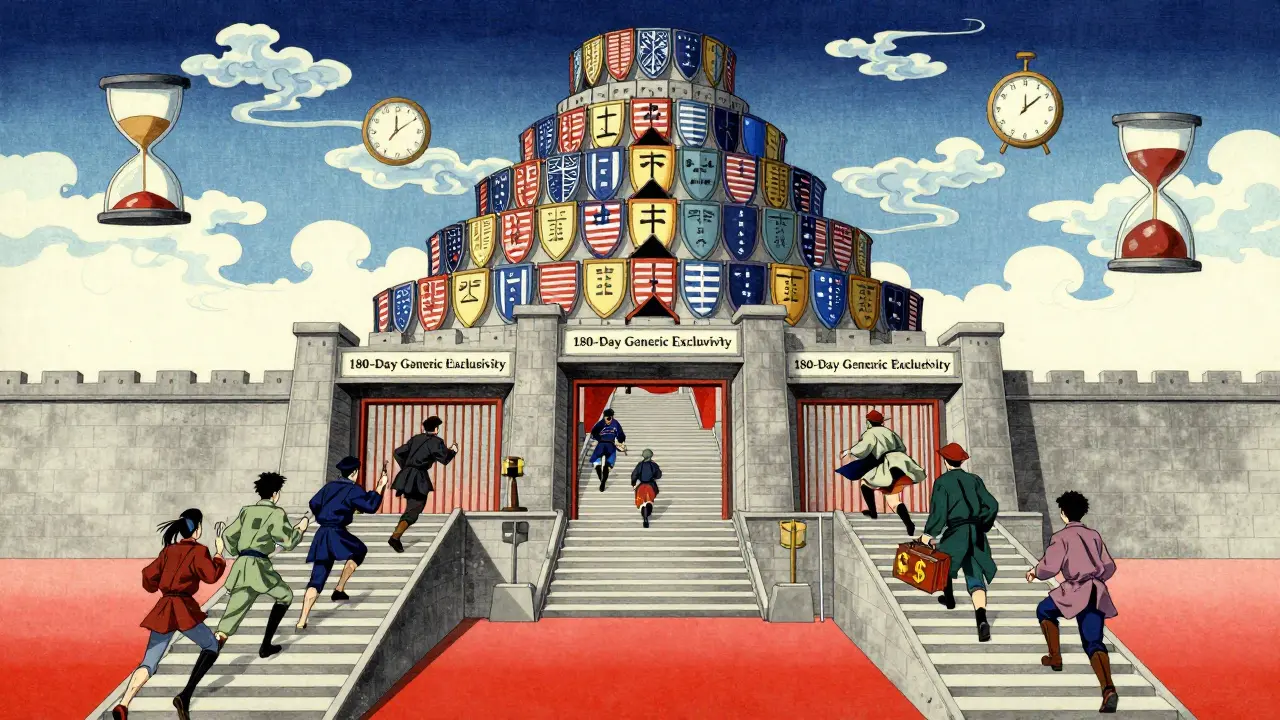
But the most controversial feature is the 180-Day Generic Exclusivity. If a generic company challenges a brand-name patent and wins (or waits for it to expire), they get 180 days of sole generic market access. This creates a fierce race among generic makers to sue first. It also leads to "pay-for-delay" settlements, where brand companies pay generic rivals to stay out of the market longer, a practice heavily scrutinized by the Federal Trade Commission. Furthermore, the U.S. allows Patent Term Extension (PTE), adding up to 5 years back to the patent life to compensate for time lost during FDA review, though the total post-approval life cannot exceed 14 years.
European Union: The Structured '8+2+1' Model
In contrast to the U.S. litigation-heavy approach, the European Union favors a more predictable, regulatory-based timeline known as the "8+2(+1)" rule. This system separates data exclusivity from market exclusivity, providing clarity for manufacturers across member states.
- 8 Years of Data Exclusivity: During this time, generic manufacturers cannot reference the original company's clinical trial data to gain approval. They must wait until this period ends before even submitting an application.
- 2 Years of Market Exclusivity: After the 8 years, generics can submit applications, but they cannot be sold on the market for another 2 years. This gives regulators time to review the generic submissions.
- +1 Year Extension: If the originator company identifies significant new therapeutic benefits (usually through pediatric studies) within the first 8 years, they can add one extra year of market protection.
To compensate for the loss of effective patent life due to regulatory delays, the EU offers Supplementary Protection Certificates (SPCs). An SPC can extend protection by up to 5 years, but there is a hard cap: the total protection from the initial marketing authorization cannot exceed 15 years. For orphan drugs, the EU grants 10 years of exclusivity, extendable by 2 years if a pediatric investigation plan is completed. This structured approach reduces the legal battles seen in the U.S., leading to more predictable generic entry dates, though critics argue it may offer less incentive for incremental innovations compared to the U.S. system.
Canada, Japan, and Emerging Markets
Other major markets have carved out their own paths, often blending elements of the U.S. and EU models while adapting to local economic pressures.
Canada closely mirrors the EU with an 8-year data protection period followed by 2 years of market exclusivity. However, Canada has faced criticism for slow regulatory processing times, which can inadvertently delay generic entry despite the clear statutory deadlines. Recent reforms aim to streamline these processes to improve access.
Japan offers 8 years of data exclusivity and 4 years of market exclusivity for new chemical entities. The Japanese model places a heavy emphasis on rapid adoption of innovative therapies, often negotiating prices directly with manufacturers after launch. In late 2023, Japan's Pharmaceuticals and Medical Devices Agency (PMDA) announced plans to further streamline its patent linkage system to accelerate generic availability, reflecting a growing priority on cost containment.
In emerging markets, the landscape is shifting rapidly. China, once a hub for generic manufacturing with minimal IP protection, extended its data exclusivity from 6 to 12 years in 2020 to attract foreign innovation. Similarly, Brazil implemented 10 years of data protection in 2021. These changes signal a global trend toward stricter IP regimes, which experts warn could delay generic access in lower-income regions unless balanced by robust compulsory licensing provisions.
| Region | Data Exclusivity | Market Exclusivity | Patent Extension Mechanism | Total Max Protection* |
|---|---|---|---|---|
| United States | 5 years (NCE) | Variable (via PTE) | Patent Term Extension (up to 5 yrs) | Up to 14 years post-approval |
| European Union | 8 years | 2 years (+1 optional) | Supplementary Protection Certificate (SPC) | 15 years from first MA |
| Canada | 8 years | 2 years | Patent Term Restoration | Varies |
| Japan | 8 years | 4 years | Patent Term Extension | Varies |
*Note: Total protection varies based on specific drug type, pediatric extensions, and regulatory review times.
The Real-World Impact: Evergreening and Delays
These legal frameworks are not just theoretical; they drive aggressive corporate strategies. One common tactic is "evergreening," where originator companies file dozens of minor patents on dosage forms, delivery mechanisms, or manufacturing processes. A 2022 analysis by LexisNexis PatentSight found that top pharma companies maintain an average of 137 patents per drug product. This creates a "patent thicket" that generic manufacturers must navigate, often costing $2-5 million in legal fees per product to challenge.
Dr. Aaron Kesselheim of Harvard Medical School noted in 2021 that the current system allows originators to obtain an average of 38 additional patents per drug, effectively extending monopolies far beyond the intended period. Conversely, industry representatives like Dr. John Towery of PhRMA argue that without these protections, the high failure rate of clinical trials (14% in Phase III) would make innovation financially unsustainable.
The result is a stark disparity in access. A 2022 WHO analysis revealed that originator drugs reach generic status in high-income countries after a median of 12.7 years, compared to 19.3 years in low-income countries. This delay is largely due to differing interpretations of data exclusivity in trade agreements, which can block generic competition even after patents expire. For example, Health Action International documented that data exclusivity provisions delayed generic HIV medications in South Africa by up to 11 years beyond patent expiration.
Future Trends: Rebalancing the Scales
As of 2026, pressure is mounting to reform these systems. With US$356 billion of branded sales facing patent cliffs between 2023 and 2028, the stakes have never been higher. Legislative efforts like the U.S. Preserve Access to Affordable Generics and Biosimilars Act aim to curb anti-competitive pay-for-delay settlements. Meanwhile, the EU's 2023 pharmaceutical legislation proposals seek to modernize the 8+2+1 framework, potentially reducing data exclusivity for some drugs while strengthening incentives for truly innovative medicines.
For patients and prescribers, understanding these timelines is key to advocating for timely access. Knowing when a drug's exclusivity period ends allows for better planning around formulary switches and budget allocations. As global regulations continue to evolve, the tension between rewarding innovation and ensuring equitable access will remain the defining challenge of pharmaceutical policy.
What is the difference between a patent and exclusivity?
A patent is a legal right granted by the government that prevents others from making, using, or selling the invention for a set period (usually 20 years from filing). Exclusivity is a regulatory privilege granted by health agencies (like the FDA or EMA) that prohibits them from approving generic versions of a drug for a specific time, regardless of patent status. Exclusivity can sometimes last longer than the patent itself.
How long does it take for a generic drug to enter the market in the US?
It depends on the type of exclusivity. For New Chemical Entities, generics cannot submit applications for 5 years. For other drugs, it may be 3 years. However, if the brand company has valid patents listed in the Orange Book, generics must challenge them, which can delay entry for several more years through litigation. Once patents expire or are invalidated, generics can enter immediately.
What is the '8+2+1' rule in Europe?
The '8+2+1' rule refers to the EU's data and market exclusivity structure. It consists of 8 years of data exclusivity (generics can't use originator data), plus 2 years of market exclusivity (generics can't sell), plus an optional 1-year extension if the originator demonstrates significant new therapeutic benefits, usually via pediatric studies.
Why do some generic drugs still cost a lot?
High generic prices often occur when there is only one generic manufacturer on the market, allowing them to maintain monopoly-like pricing. Additionally, if the brand company has successfully delayed generic entry through patent litigation or supply chain issues, competition hasn't had time to drive prices down. True price drops usually happen when multiple generic competitors enter the market.
Can countries ignore patent laws to provide cheap medicines?
Yes, through a mechanism called compulsory licensing. Under TRIPS agreements, governments can authorize the production of patented drugs without the consent of the patent holder in cases of national emergency or public non-commercial use. However, this is politically sensitive and rarely used by developed nations, though it remains a critical tool for improving access in low-income countries.