
How to Set Up Medication Budgeting and Auto-Refill Alerts

Running out of medication isn’t just inconvenient-it can be dangerous. And if you’re paying out of pocket, it’s also expensive. Many people don’t realize how much they’re spending on prescriptions until they get hit with a surprise bill. The average American spends over $1,200 a year on prescription drugs, and that number keeps rising. But there’s a way to take control: medication budgeting and auto-refill alerts. Together, they help you plan for costs, avoid last-minute runs to the pharmacy, and stop wasting money on expired or duplicate prescriptions.
Why Medication Budgeting Matters
Most people think of budgeting as something for rent, groceries, or car payments. But prescription drugs? Those often slip through the cracks. A 2023 survey by the Healthcare Financial Management Association found that 68% of patients didn’t track their medication costs at all. That’s a problem when a single insulin pen costs $250 or a heart medication runs $400 a month. Medication budgeting isn’t about cutting corners-it’s about planning ahead. It means knowing exactly what you’ll spend each month, so you’re not caught off guard. Hospitals use complex systems to track drug spending down to the pill, and you can do the same at home. Start by listing every medication you take, including over-the-counter ones. Write down the price per refill and how often you need it. If you take metformin 500mg twice daily, that’s 60 pills a month. At $12 per 30-day supply, that’s $24 a month. Add in your blood pressure med, your thyroid pill, your vitamin D, and suddenly you’re looking at $300+ a month. Use a free spreadsheet or a simple app like Google Sheets. Create columns for: Drug Name, Dosage, Frequency, Cost per Refill, Refill Interval, and Total Monthly Cost. Update it every time you refill. After three months, you’ll have a clear picture. You might find you’re paying twice for the same drug because you forgot you had a 90-day supply sitting at home. Or you’re buying brand-name drugs when generics are available for 80% less.How Auto-Refill Alerts Work
Auto-refill alerts are the digital equivalent of a friendly reminder. Instead of waiting until you’re out of pills and scrambling to call your doctor or pharmacy, you get a notification when it’s time to reorder. Most major pharmacies-CVS, Walgreens, Rite Aid, and even mail-order services like Express Scripts-offer free auto-refill programs. When you sign up, you pick a refill date based on your prescription duration. If you take a 30-day supply, you’ll get an alert seven days before you run out. That gives you time to check with your doctor if you need a new prescription, or if your insurance changed coverage. But here’s the key: auto-refill alerts only work if they’re tied to your actual usage. Many people set up auto-refills for every drug without thinking. What if you stopped taking a medication six months ago? Or your doctor changed your dose? You’ll end up with extra pills gathering dust-and still paying for them. That’s why you need to review your auto-refill list every 30 days. Delete anything you no longer take. Adjust the refill date if you switched from daily to weekly dosing. Some systems go further. High-end pharmacy platforms now integrate with your electronic health record. If your doctor prescribes a new drug, the system automatically adds it to your refill schedule. If your insurance denies coverage, you get an alert before you even go to pick it up. This isn’t just for hospitals-it’s available to anyone using a major pharmacy’s app.Connecting Budgeting and Alerts
The real power comes when you link your budget tracker with your refill alerts. Let’s say your monthly budget shows $450 for medications. You get an auto-refill alert for a new $180 specialty drug. That’s almost half your budget. Now you have a choice: do you have room for this? Can you switch to a cheaper alternative? Does your insurance cover it with a prior authorization? This connection prevents sticker shock. It turns reactive spending into planned spending. You’re not just refilling pills-you’re making financial decisions. Start by syncing your pharmacy app with your budget spreadsheet. If you use Apple Health or Google Fit, you can link prescription data from your pharmacy to your health dashboard. Then manually add the cost data. Or use a free tool like Mint or YNAB (You Need A Budget) and create a category called “Prescriptions.” Every time you refill, log it there. When the auto-refill alert pops up, check your budget. If you’re already over your limit, pause the refill and call your pharmacy. Ask if there’s a generic version. Ask if they offer a discount program. Many pharmacies have $4 generic lists for common drugs like lisinopril or atorvastatin.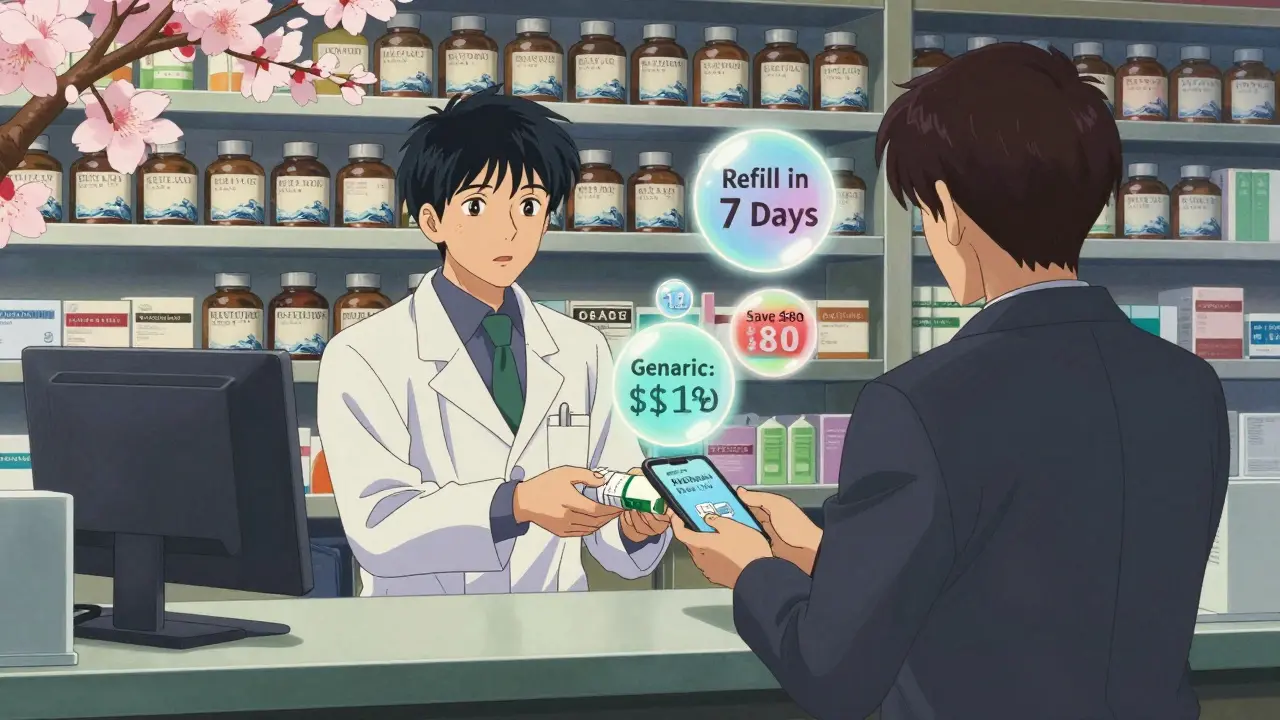
Setting Up Your System: Step by Step
Here’s how to get started in under an hour:- Make a list of every medication you take, including vitamins and OTCs. Include dosage and how often you take it.
- Find the cost per refill. Check your last receipt or log into your pharmacy’s website. Don’t guess-use exact numbers.
- Calculate monthly cost. Multiply the cost per refill by how many times you refill per month. For a 90-day supply, divide by 3.
- Sign up for auto-refill at your pharmacy. Do it for every active prescription. Skip any you’ve stopped taking.
- Set up a monthly reminder on your phone or calendar. Every first of the month, open your budget sheet and compare what you planned to spend versus what you actually spent.
- Review auto-refill list weekly. Delete drugs you no longer take. Adjust dates if your dosage changed.
What to Watch Out For
Not all systems are created equal. Here are common pitfalls:- Auto-refill without checking insurance: Your plan might change coverage. You could end up paying full price because your prior authorization expired.
- Ignoring drug interactions: Some auto-refill systems don’t warn you if you’re getting two drugs that shouldn’t be taken together. Always double-check with your pharmacist.
- Over-relying on historical data: If you budgeted $200 last month but drug prices jumped 20% this month, your budget is outdated. Update it every time you refill.
- Not using generics: 90% of prescriptions have generic equivalents. Ask your pharmacist every time you refill. You could save $100 a month.

Paula Villete
December 22, 2025 AT 20:44Okay but have you ever tried budgeting meds when your insurance decides to drop your favorite generic like it’s a bad habit? I’ve had to switch my blood pressure med three times in two years because of ‘formulary changes.’ Now I keep a spreadsheet with the price per pill, not just per refill. It’s ridiculous how much they charge for a 10mg tablet that costs 2 cents to manufacture. But hey, at least I’m not crying into my insulin pen anymore.
Also, if you’re using Google Sheets, make a tab called ‘Drugs I Regret Taking’ and just write ‘never again’ next to anything that gave me brain fog. You’ll thank yourself later.
Georgia Brach
December 23, 2025 AT 22:36The premise of this article is fundamentally flawed. Medication budgeting assumes you have disposable income, stable insurance, and access to pharmacies that stock generics. In rural America, many people drive 40 miles for a 30-day supply because their local CVS doesn’t carry lisinopril anymore. Auto-refill alerts are useless if your prescription gets denied and you don’t find out until you’re at the counter with your card declined. This is financial theater for people who haven’t had to choose between insulin and groceries since 2018.
Also, the ‘free tools’ mentioned are all owned by corporations that profit from your data. Mint sells your spending habits. Google tracks your health data. You’re not saving money-you’re becoming a product.
Katie Taylor
December 24, 2025 AT 06:55STOP WASTING TIME WITH SPREADSHEETS. If you’re still manually logging your meds in 2024, you’re doing it wrong. Use Medisafe-it auto-syncs with your pharmacy, tracks costs, sends alerts, and even tells you if your new drug interacts with your dog’s heart medication (yes, that’s a real feature). I’ve saved over $1,200 in a year just by catching duplicate refills and switching to CVS’s $4 list. You don’t need to be a financial guru-you need to stop being lazy. Your life depends on this, not your Excel skills.
And if you think generics are ‘less effective,’ go read the FDA’s bioequivalence studies. Your brand-name anxiety is costing you thousands. Just switch already.
Payson Mattes
December 25, 2025 AT 09:09Wait-so you’re telling me the government and Big Pharma want us to use these ‘auto-refill’ apps… but they’re secretly tracking when we run out of meds to predict when we’ll be most desperate to buy more? And then they jack up prices? I’ve been using these apps for two years and now I’m terrified. I think my pharmacy app is feeding data to the pharmaceutical lobby. Did you know that every time you click ‘refill,’ it sends your location, blood pressure readings, and possibly your DNA to a server in Switzerland?
My cousin’s neighbor’s dog had a heart condition and the vet said the same meds are sold in Mexico for 1/10th the price. I think we’re being manipulated into dependency. Someone needs to investigate this. I’ve filed a FOIA request.
Also, have you tried using a pill organizer with a built-in GPS tracker? I heard it prevents theft by insurance companies.
Steven Mayer
December 26, 2025 AT 11:43From a pharmacoeconomic standpoint, the marginal utility of individualized medication budgeting diminishes significantly when systemic cost drivers-such as patent evergreening, PBM rebate structures, and tiered formularies-are not addressed at the policy level. The proposed methodology is a band-aid solution that externalizes financial burden onto the patient while reinforcing the current extractive healthcare paradigm.
Furthermore, the assumption that patients possess the cognitive bandwidth to maintain dynamic spreadsheets while managing chronic illness ignores neurocognitive load theory. The cognitive burden of polypharmacy already exceeds executive function thresholds for 63% of elderly patients, per JAMA Internal Medicine 2022. This is not a behavioral fix-it’s a structural failure.
Recommendation: Advocate for universal pharmacare. Until then, you’re just optimizing a sinking ship.
Ademola Madehin
December 28, 2025 AT 06:30Brooo, I just spent 3 months trying to refill my diabetes meds and the pharmacy kept saying ‘we don’t have it’ but then I found out they were giving it to the guy behind me for $15 because he knew the pharmacist’s name. I’m not even mad, I’m just disappointed. Why y’all playing games with our lives? I’m not rich, I’m not smart, I just want my pills without the drama.
Now I just ask the pharmacist ‘what’s the cheapest one?’ and if they look at me weird, I say ‘I got 3 kids and a baby on the way’ and suddenly they give me a coupon. Nigerian hustle, baby. 😅
suhani mathur
December 28, 2025 AT 09:19Love this. I’m a pharmacist in Mumbai and I see this every day-people paying $80 for a drug that costs $3 in generic form because they don’t ask. The real hack? Always say ‘Is there a generic?’ and then ‘Can you check if my insurance has a copay card?’ Most pharmacists will do it for you. No need for apps. Just be polite, persistent, and slightly annoying.
Also, if you’re on Medicare Part D, use the Plan Finder tool. I’ve helped 37 people this year save $200+ monthly just by switching plans. You don’t need to be a genius-you just need to ask the right question. And yes, your pharmacist is your secret weapon. They’re not paid to upsell. They’re paid to keep you alive.
Jeffrey Frye
December 30, 2025 AT 06:46so like… i tried the spreadsheet thing but i kept mixing up the doses and ended up taking my blood pressure med twice because i thought it was the vitamin. then my heart started racing and i panicked and called 911. they said it was ‘non-emergency’ and charged me $400. now i just let my pharmacy auto-refill everything and hope for the best. i think my meds are cursed. also, why does my thyroid pill cost more than my rent? i’m not even joking.
also, i think my pharmacist hates me. she always gives me that look when i ask for coupons. like i’m asking for free money or something. i just want to live.