
How to Simplify Complex Medication Regimens for Older Adults

Imagine taking eight different pills at four different times a day-some with food, some on an empty stomach, others at bedtime. Now imagine doing that every single day, with shaky hands, fading memory, and no one nearby to help. This isn’t rare. In fact, medication simplification is one of the most urgent, yet overlooked, needs for older adults today. Nearly 40% of people over 65 in the U.S. take five or more medications daily. In Australia, that number is rising fast. And for many, it’s not just inconvenient-it’s dangerous.
Why Medication Regimens Get So Complicated
Older adults often see multiple specialists. One doctor treats their blood pressure, another their diabetes, a third their arthritis, and maybe a fourth their sleep or depression. Each prescribes what they think is best. But no one steps back to look at the whole picture. The result? A cluttered medicine cabinet with pills that don’t work together, times that clash, and duplicates that aren’t even needed. A 2020 study found that the average older adult on a complex regimen had six discrepancies between what their doctor thought they were taking and what they were actually taking. That’s not a mistake-it’s a system failure. And it’s why simplification isn’t just about fewer pills. It’s about safety, dignity, and independence.Three Proven Ways to Simplify Medication Regimens
There are three main strategies that work-and they’re not just theoretical. They’re being used in aged care homes, community pharmacies, and home visits across Australia and the U.S.- Fixed-dose combinations: Instead of taking two separate pills-one for blood pressure, one for cholesterol-switch to a single pill that contains both. This cuts pill count and reduces confusion. For example, a combination of amlodipine and atorvastatin is now widely available and just as effective as taking them separately.
- Once-daily dosing: Many medications come in long-acting versions. Instead of taking a blood pressure pill twice a day, switch to a once-daily extended-release version. The same goes for antidepressants, statins, and even some diabetes drugs. These aren’t new drugs-they’re just formulated to last longer.
- Combining both: The most powerful approach is reducing both the number of pills and the number of times you take them. For instance, switching from three daily doses of two different meds to one pill taken once a day. This cuts the daily routine from six doses down to one.
A 2020 trial in the U.S. showed that 41% of medication regimens could be simplified just by adjusting dosing times and switching to longer-acting forms. In Australia, pharmacists using the MRS GRACE tool were able to simplify regimens for over half of the residents they reviewed.
The MRS GRACE Tool: A Simple Framework for Real Change
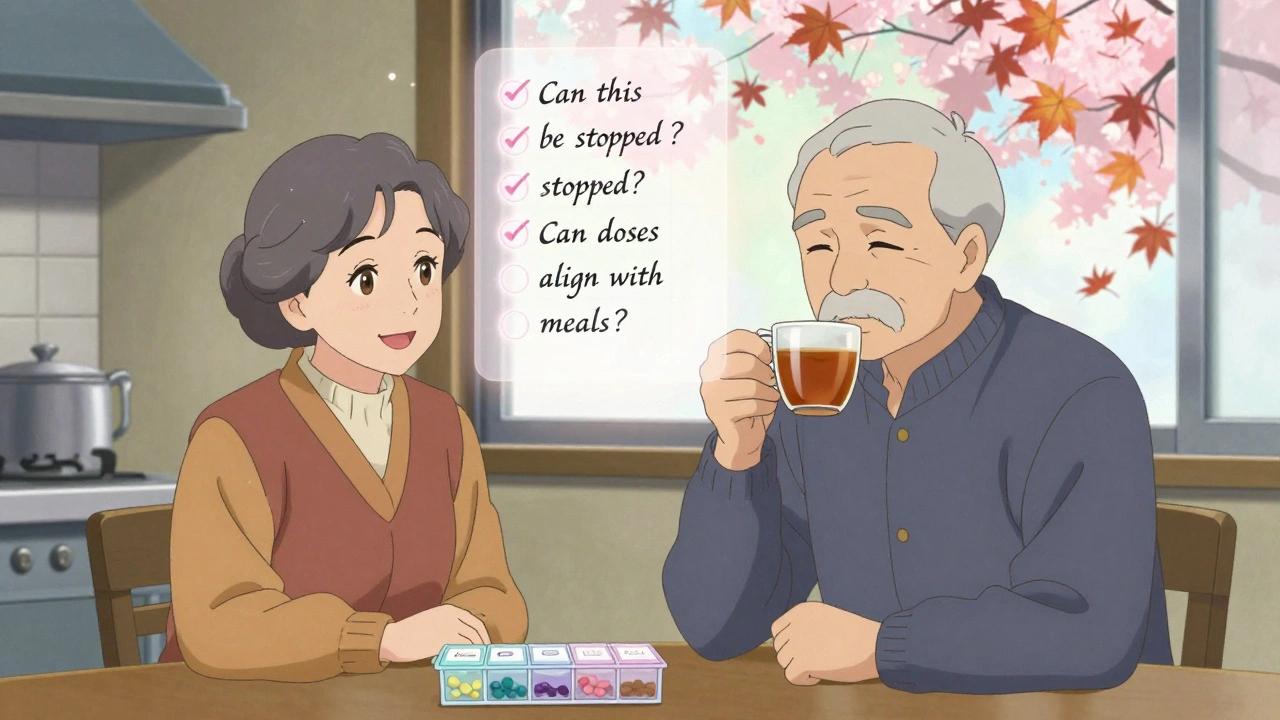
You don’t need fancy tech or a PhD to start simplifying. The MRS GRACE tool-developed in Australia and validated in aged care settings-uses five clear questions:- Can any medications be stopped entirely (deprescribing)?
- Can any drugs be switched to a once-daily version?
- Can any two pills be combined into one?
- Can dosing times be aligned with daily routines (like meals or bedtime)?
- Is the patient’s ability to manage their meds being accurately assessed?
This isn’t a checklist for pharmacists only. Family members and caregivers can use it too. Start by asking: “Do you really need to take this at 7 a.m., 1 p.m., and 9 p.m.?” Often, the answer is no.
One aged care facility in Melbourne saw a 30% drop in medication errors after staff started using MRS GRACE. Why? Because they stopped guessing. They started asking.

When Simplification Doesn’t Work-And Why
Not every pill can be simplified. Some medications need precise timing to work-or to avoid side effects.- Thyroid medicine (like levothyroxine) must be taken on an empty stomach, at least 30 minutes before breakfast. Moving it to bedtime can reduce absorption.
- Statins (for cholesterol) work best at night, when the liver makes most cholesterol.
- Some diuretics (water pills) can’t be taken at night because they cause frequent urination, disrupting sleep.
These aren’t deal-breakers. They’re red flags. If a medication has strict timing rules, don’t force it into a simplified schedule. Instead, ask: “Is there a long-acting alternative?” or “Can we combine it with another drug that’s already taken at this time?”
A 2019 German study found that simplifying insulin regimens improved adherence by 45%. But for blood pressure pills, the same approach didn’t always improve outcomes-just adherence. That’s the key difference: fewer pills don’t always mean better health. But better adherence? That almost always does.
Who Should Lead This Effort?
Many assume doctors should handle this. But the truth? Pharmacists are the real experts in medication simplification.Doctors focus on diagnosis and prescribing. Pharmacists focus on how the medicine is taken, how it interacts, and whether it’s manageable. A 2021 study showed that when pharmacists led medication reviews, 50% of recommended simplifications were actually implemented-compared to just 18% when doctors tried alone.
In New Zealand and Australia, pharmacists can now perform Medication Management Reviews (MMRs) under Medicare and the Pharmaceutical Benefits Scheme. These are 20-60 minute sessions where a pharmacist sits down with the patient, reviews every pill, checks for duplicates, and proposes simplifications. It’s free for eligible seniors.
If you’re caring for an older adult, ask: “Has a pharmacist done a full medication review this year?” If not, schedule one. It takes one call.
The Hidden Benefit: More Than Just Adherence
Simplifying meds isn’t just about remembering to take them. It’s about reclaiming time, reducing anxiety, and restoring control.One woman in her late 70s, living alone in Auckland, used to spend 45 minutes every morning sorting her pills into a dosette box. She’d forget which ones went where. She’d get frustrated. She’d skip doses. After her pharmacist switched her from eight daily doses to three once-daily combinations, she told them: “I feel like I got my morning back.”
That’s the real win. Less stress. Fewer hospital trips. More independence. And for caregivers? Less time managing pills, more time being present.
What to Do Next: A Simple Action Plan
You don’t need to fix everything at once. Start here:- Collect every pill: Gather all medications, including supplements, over-the-counter drugs, and creams. Put them on the table.
- Write down the schedule: Note what each pill is for, how many, and when it’s taken.
- Call a pharmacist: Ask for a Medication Management Review. Say: “I’m worried my mom/dad is taking too many pills. Can you help simplify this?”
- Ask about deprescribing: Don’t assume every pill is still needed. Ask: “Is this still necessary?” Many older adults are on drugs prescribed years ago that no longer apply.
- Use a dosette box wisely: Only use it if it reduces confusion-not adds to it. Some people do better with a simple pill organizer with just morning, afternoon, and night slots.
Don’t wait for a crisis. Don’t wait for a hospital visit. Start now.
What’s Holding Us Back?
Despite all the evidence, simplification still isn’t routine. Why?- Time: A full review takes 30-60 minutes. Most GP appointments are 10.
- Training: Only 35% of pharmacy schools teach medication simplification as a core skill.
- Reimbursement: In many places, pharmacists aren’t paid for the time they spend reviewing meds.
- Assumption: Many believe “if it’s prescribed, it must be needed.” That’s not true.
But change is coming. In Germany, pharmacists get paid extra for doing simplification reviews. In the U.S., Medicare Advantage plans now reward providers for reducing hospital readmissions linked to medication errors. And in Australia, 85% of aged care homes now have some form of simplification protocol built in.
It’s not perfect. But it’s moving.
Final Thought: It’s Not About Fewer Pills. It’s About Better Living.
Simplifying a medication regimen isn’t about cutting corners. It’s about cutting clutter. It’s about making sure the medicine works for the person-not the other way around.For older adults, the goal isn’t just to live longer. It’s to live well. To sleep through the night. To eat breakfast without a pill schedule hanging over their head. To feel in control again.
That’s what simplification really gives: not just adherence. But freedom.
Can I just stop a medication if it seems unnecessary?
No. Never stop a medication without talking to a doctor or pharmacist first. Some drugs, like blood pressure or antidepressant medications, can cause serious withdrawal effects if stopped suddenly. Even if a pill seems unnecessary, it may have been prescribed for a reason that’s no longer obvious. A professional review is essential to determine what’s safe to stop.
Are combination pills as effective as taking separate ones?
Yes. Fixed-dose combination pills are designed to deliver the same amount of active ingredients as taking two separate pills. They’re tested for safety and effectiveness just like individual drugs. In fact, some studies show better adherence because patients are more likely to take one pill than two. The only exception is if a patient needs different doses of each component-then separate pills may still be needed.
How do I know if my parent’s medication list is too complex?
If they take more than five medications daily, or if they need to take pills at four or more different times each day, their regimen is likely complex. Other signs: forgetting doses, using multiple pill organizers, saying they’re overwhelmed by their meds, or having recent falls or confusion that could be linked to side effects. A pharmacist can assess this using tools like MRS GRACE.
Does simplifying meds reduce hospital visits?
Yes-indirectly. While simplification doesn’t always improve lab results or blood pressure numbers directly, it consistently improves adherence. And better adherence means fewer emergency visits due to missed doses, overdoses, or side effects. One U.S. study found that older adults whose regimens were simplified had 22% fewer hospital admissions over 12 months.
Is medication simplification covered by insurance?
In Australia and New Zealand, Medication Management Reviews (MMRs) are fully covered by Medicare for eligible seniors. In the U.S., Medicare Advantage plans often cover comprehensive medication reviews, especially if there’s a history of hospitalization or polypharmacy. Always ask your pharmacist: “Is this service covered?” Many people don’t know it’s free.
What if my parent refuses to simplify their meds?
It’s common. Some people feel safer with more pills, or they’ve been taking them for years and see them as part of their routine. Don’t force it. Instead, start small. Ask them to try one change: maybe switching from three pills a day to two. Or moving one dose to match breakfast. Let them see how much easier it feels. Often, the relief speaks louder than any argument.
nina nakamura
December 13, 2025 AT 03:35Bruno Janssen
December 13, 2025 AT 12:17Emma Sbarge
December 14, 2025 AT 11:11Michael Gardner
December 16, 2025 AT 00:27Ronan Lansbury
December 17, 2025 AT 11:28Shelby Ume
December 19, 2025 AT 03:05Jade Hovet
December 20, 2025 AT 13:09nithin Kuntumadugu
December 21, 2025 AT 09:54John Fred
December 23, 2025 AT 05:48Harriet Wollaston
December 23, 2025 AT 15:45Lauren Scrima
December 24, 2025 AT 22:25