
How to Spot Expired Medications: Visual Signs of Color, Odor, and Texture Changes

Have you ever found a bottle of pills in your cabinet that looked slightly different than when you first bought it? Maybe the white tablets turned a faint yellow, or the cream separated into oil and water. It’s easy to ignore these small changes, but they can signal that your medication has degraded. Taking expired or chemically altered drugs isn’t just ineffective; it can be dangerous. The U.S. Food and Drug Administration (FDA) is the federal agency responsible for protecting public health by ensuring the safety, efficacy, and security of human and veterinary drugs warns that physical changes often precede chemical breakdown. Understanding how to recognize these signs is a critical part of personal healthcare management.
This guide breaks down exactly what to look for in color, odor, and texture across different types of medications. We’ll cover why these changes happen, how to inspect your stash safely, and when it’s time to toss the bottle. By learning to spot these red flags, you protect yourself from adverse reactions and ensure your treatments work as intended.
Why Physical Changes Matter in Expired Drugs
Medications don’t just stop working on their expiration date like a light switch flipping off. Instead, they undergo a gradual process of chemical degradation. Over time, exposure to heat, light, and moisture causes the active ingredients to break down or transform into new compounds. These chemical shifts manifest as physical changes you can see, smell, or feel.
The World Health Organization estimates that over 10% of expired medications show significant physical alterations that affect safety. For example, tetracycline antibiotics can turn brown due to oxidation, creating toxic byproducts that harm the kidneys. While some changes are merely cosmetic, others indicate that the drug is no longer potent or safe. Recognizing these signs early prevents you from administering a degraded dose that could fail to treat an infection or cause unexpected side effects.
Visual Inspection: Spotting Color Changes
Discoloration is the most common sign of medication degradation, appearing in nearly 70% of expired solid dosage forms according to long-term stability studies. Your eyes are the first line of defense, but you need to know what normal looks like versus what’s gone wrong.
| Medication Type | Normal Appearance | Signs of Degradation |
|---|---|---|
| Tablets (e.g., Aspirin) | White or off-white, uniform | Yellowing, brown spots, or pinkish tint |
| Capsules (e.g., Amoxicillin) | Bright colors, smooth shells | Fading, darkening, or shell cracking |
| Liquids (e.g., Cough Syrup) | Clear or consistent opacity | Cloudiness, separation, or color shift |
| Ointments (e.g., Hydrocortisone) | Uniform white or pale yellow | Darkening or visible oil pooling |
To check for discoloration, take the pill out of the bottle and hold it against a plain white background under bright light. Look for uneven coloring, especially around the edges or where the tablet was scored. If a white pill has developed gray or brown speckles, it’s likely absorbing moisture or oxidizing. For liquids, hold the bottle up to the light. A clear solution that turns cloudy or develops floating particles indicates microbial growth or chemical precipitation. Remember, some medications naturally change color slightly with age, so compare your current supply with a fresh bottle if possible.
Texture and Consistency: Touching for Trouble
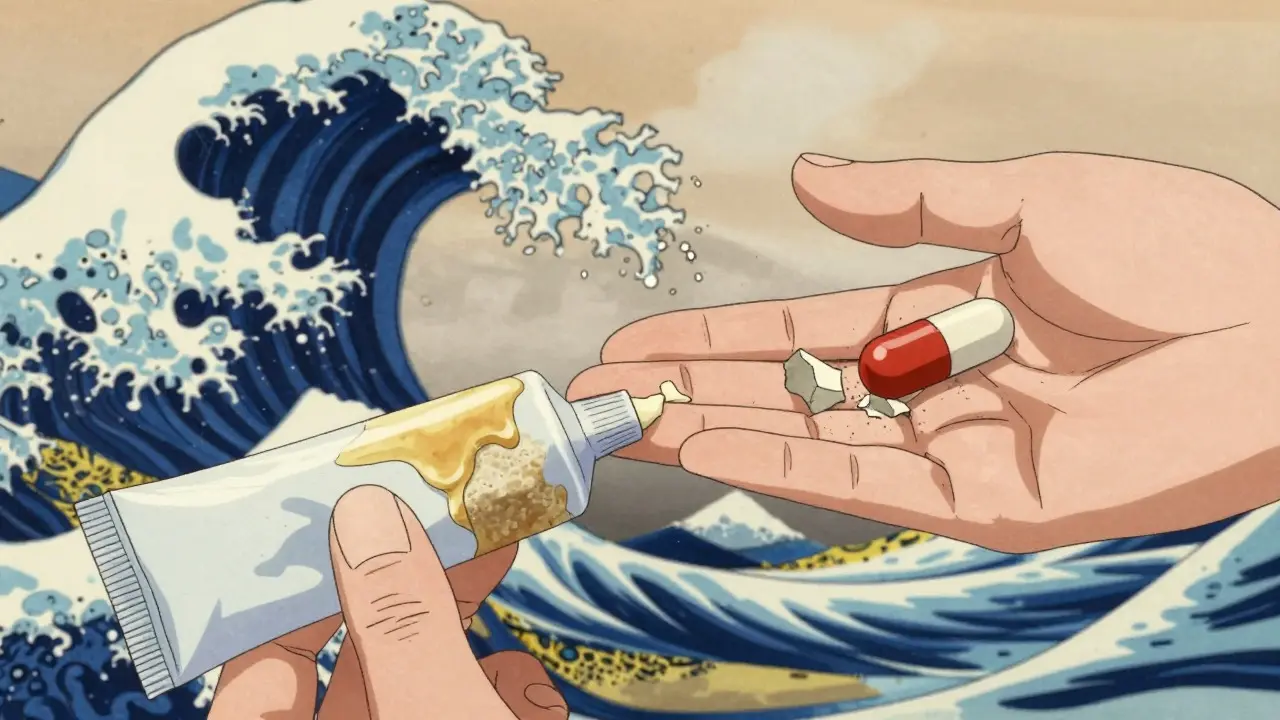
If a medication feels different, trust your instincts. Texture changes often reveal internal structural breakdowns that aren’t immediately visible. This is particularly important for semisolids like creams, gels, and ointments, which are prone to phase separation.
- Tablets and Capsules: Check for crumbling or sticking together. Tablets should be hard and intact. If they crumble easily in your hand or stick together in clumps, they’ve absorbed too much moisture. This "caking" compromises the drug’s ability to dissolve properly in your stomach, meaning you might not get the full dose.
- Creams and Ointments: Squeeze a small amount onto your finger. It should spread smoothly. If you see liquid pooling on top (oil-off) or the base becoming grainy and dry (water-off), the emulsion has broken. This means the active ingredient may have concentrated in one part while the other part is inactive, leading to inconsistent dosing.
- Inhalers and Sprays: Shake the device gently. If it feels unusually heavy or light, or if the spray comes out as a mist rather than a fine aerosol, the propellant may have leaked or the suspension has settled irreversibly.
NASA’s research on pharmaceutical stability in spaceflight highlighted that liquefaction in ointments and caking in capsules are predictable signs of failure. In your home bathroom, humidity is the main culprit. If your bathroom lacks ventilation, the steam from showers accelerates this texture degradation. Keep medications in cool, dry places to maintain their integrity.
Odor Checks: Smelling for Safety
Your sense of smell is surprisingly effective at detecting chemical changes. Many drugs have distinct odors, and when those odors change, it signals molecular breakdown. However, use caution-never sniff directly into a bottle, as concentrated vapors can irritate your nose or lungs.
Gently wave the open container toward your nose. What should you expect?
- Sweet or Chemical Smells: Some syrups and liquids have added flavorings. If the sweet scent fades or is replaced by a sour, fermented, or alcoholic odor, bacterial contamination or fermentation may have occurred. This is common in older cough syrups or insulin solutions.
- Foul or Rotten Odors: A strong, unpleasant smell in any medication is a major red flag. Antibiotics like penicillin can develop a musty odor as they degrade. If a previously neutral-smelling pill now smells sharp or acidic, the chemical structure has likely altered.
- No Change: Interestingly, the absence of a smell change doesn’t guarantee safety. Some potent drugs degrade silently. Always combine odor checks with visual and texture inspections for a complete assessment.
If a medication smells "off," discard it immediately. Do not taste it to confirm. Tasting unknown chemicals can lead to accidental poisoning or severe allergic reactions.
High-Risk Medications: What to Watch Closely
Not all drugs are created equal when it comes to stability. Certain classes of medications are more sensitive to environmental factors and degrade faster, making them higher risks if expired.
- Nitroglycerin: Used for chest pain, this drug is highly volatile. It loses potency rapidly, even before the expiration date, if exposed to air or light. If the tablets appear discolored or crumble, they are useless in an emergency.
- Insulin: Clear insulin solutions should remain clear. If they become cloudy (unless it’s specifically a cloudy formulation like NPH), contain particles, or stick to the vial walls, the protein structure has denatured. Injecting degraded insulin can lead to unpredictable blood sugar levels.
- Antibiotics: As mentioned, tetracyclines and penicillins are prone to oxidation and hydrolysis. Degraded antibiotics not only fail to kill bacteria but can sometimes create toxic metabolites. Never risk taking an old antibiotic for a serious infection.
- EpiPens (Epinephrine): These life-saving devices have a strict shelf life. If the solution inside turns brown or amber instead of clear, the epinephrine has oxidized and will not effectively reverse an allergic reaction.
For these high-stakes medications, strict adherence to expiration dates is non-negotiable. Don’t rely solely on visual cues; if the date has passed, replace it.

Best Practices for Storage and Inspection
Preventing degradation starts with proper storage. Most medications should be kept at room temperature (between 68°F and 77°F or 20°C-25°C) in a dry place. Avoid storing meds in the bathroom medicine cabinet, as humidity from showers fluctuates wildly. Instead, choose a drawer in a bedroom or closet.
Implement a simple monthly inspection routine:
- Check Expiration Dates: Mark your calendar to review your medicine cabinet every month. Discard anything past its date.
- Visual Scan: Quickly look for obvious discoloration, cracks, or leaks.
- Document Changes: If you’re unsure about a subtle change, take a photo. Compare it next month. Progressive changes are easier to track with images.
- Use Reference Standards: When buying a new refill, keep a spare unopened box for comparison. This gives you a baseline for color and texture.
The Research Animal Resources and Compliance (RARC) system used in veterinary research employs colored dot stickers to track expiration months. You can adopt a similar low-tech method by marking your own bottles with the month they expire using a permanent marker. This reduces cognitive load and ensures you catch expiring drugs before they degrade visibly.
When to Consult a Professional
If you’re ever in doubt, consult your pharmacist. They are trained to identify subtle signs of degradation and can advise whether a specific medication is stable enough to use slightly past its date (though this is rare and generally discouraged). Pharmacists can also provide guidance on proper disposal methods to prevent environmental contamination or accidental ingestion by children or pets.
Remember, the cost of replacing a few dollars’ worth of medication is far lower than the cost of treating a failed therapy or an adverse reaction. When in doubt, throw it out.
Can I still take medication if it’s just one month past the expiration date?
Generally, no. While some studies suggest certain solid oral drugs retain potency for years after expiration, this varies wildly by formulation and storage conditions. For critical medications like nitroglycerin, insulin, or antibiotics, even a month past expiration can mean reduced efficacy or toxicity. It is safest to replace them.
Why do my pills smell like vinegar?
A vinegar-like smell often indicates hydrolysis, where the drug molecule breaks down due to moisture exposure. This is common in aspirin, which degrades into salicylic acid and acetic acid (vinegar). If your aspirin smells strongly of vinegar, it has lost its effectiveness and should be discarded.
Is it safe to store medications in the refrigerator?
Only if the label explicitly says so. Cold temperatures can actually damage some medications, causing crystals to form in liquids or altering the texture of creams. Refrigeration introduces condensation when you take the bottle out, which adds moisture. Store only those specified for cold storage, such as certain insulins or eye drops, and keep them tightly sealed.
What does "phase separation" mean in creams?
Phase separation occurs when the oil and water components of a cream or ointment split apart. You might see a layer of clear liquid on top or a greasy residue. This means the emulsion has broken, leading to uneven distribution of the active ingredient. Applying separated cream could result in either an overdose or no effect at all.
How should I dispose of expired medications?
Do not flush most medications unless the label instructs you to. The best method is to mix them with an unpalatable substance like coffee grounds or cat litter, place them in a sealed bag, and throw them in the trash. Alternatively, many pharmacies and community law enforcement agencies host drug take-back programs where you can drop off expired drugs for safe disposal.