
How to Use Technology to Track Medication Expiration Dates
Every year, thousands of people accidentally take expired medication-sometimes because they didn’t know it was past its date. In homes, clinics, and hospitals, outdated pills, patches, and injectables sit unnoticed in drawers, cabinets, and emergency kits. The risk isn’t just ineffective treatment; it’s real danger. Allergic reactions, toxic breakdown products, and failed emergency interventions have all been linked to expired drugs. But here’s the good news: you don’t have to rely on handwritten labels or memory anymore. Technology now makes tracking expiration dates simple, accurate, and automatic-even for large collections of medication.
Why Manual Tracking Fails
Picture this: a home medicine cabinet with 20+ bottles. Some are prescription, some are over-the-counter. One was filled in 2022. Another was a leftover from a vacation in 2021. You remember the antibiotics were for a bad cough-but when was that? The label says "expires 08/2024." You check the date. It’s July 2025. You toss it. But what about the insulin? The EpiPen? The liquid painkiller your child uses once a month? You don’t check them every month. And you shouldn’t have to. Manual tracking fails because it’s inconsistent. People forget. Labels fade. Pills get moved. In nursing homes and emergency services, staff juggle dozens of patients and hundreds of medications. A single missed expiration can lead to a preventable adverse event. Hospitals in the U.S. report that up to 15% of expired medications go undetected without automated systems. That’s not just waste-it’s risk.How RFID Tracks Medications in Real Time
Radio Frequency Identification (RFID) is the most powerful tool now being used in hospitals and pharmacies to track medication expiration dates. Each medication package-whether it’s a single tablet blister pack or a vial of insulin-is tagged with a tiny, invisible RFID chip. These chips don’t need line-of-sight like barcodes. You can scan an entire tray of 50 medications in under 10 seconds. Systems like KitCheck is a medication tracking system using UHF RFID tags to monitor expiration dates, lot numbers, and inventory levels across hospital cabinets and crash carts. Also known as KitCheck RFID, it was launched in 2015 and is now used in over 900 hospitals across the U.S. and New Zealand. When a medication is within two days of expiration, the system automatically flags it. Staff get alerts on their phones or tablets. No more guessing. No more searching. At Texas Children’s Hospital, pharmacists used to spend hours manually checking 784 high-value drugs-each costing over $100. Now, with RFID, they scan entire shelves in minutes. They’ve cut inventory time by 75% and reduced expired medication waste by nearly 20%. That’s more than $150,000 saved annually just from avoiding disposal.eMAR Systems for Long-Term Care and Home Use
For nursing homes, home care agencies, and patients managing chronic conditions, eVero is an electronic Medication Administration Record system that syncs with pharmacy orders, logs administration times, and sends automatic alerts when medications are nearing expiration. It’s designed for facilities serving patients with intellectual and developmental disabilities. Unlike RFID, which tracks physical inventory, eMAR focuses on the patient’s medication schedule. Imagine a caregiver giving daily pills to a resident with dementia. The system shows which meds are due, which ones were taken, and which ones are about to expire. If a bottle of blood pressure pills expires next week, the system sends a notification to the pharmacy to reorder. It even logs who gave the dose and when-critical for compliance with state and federal regulations. These systems integrate directly with pharmacy databases. When a prescription is filled, the expiration date is automatically uploaded. No manual entry. No typos. No lost paperwork. In New Zealand, several home care providers have adopted eVero since 2022, reporting a 90% drop in medication-related incidents.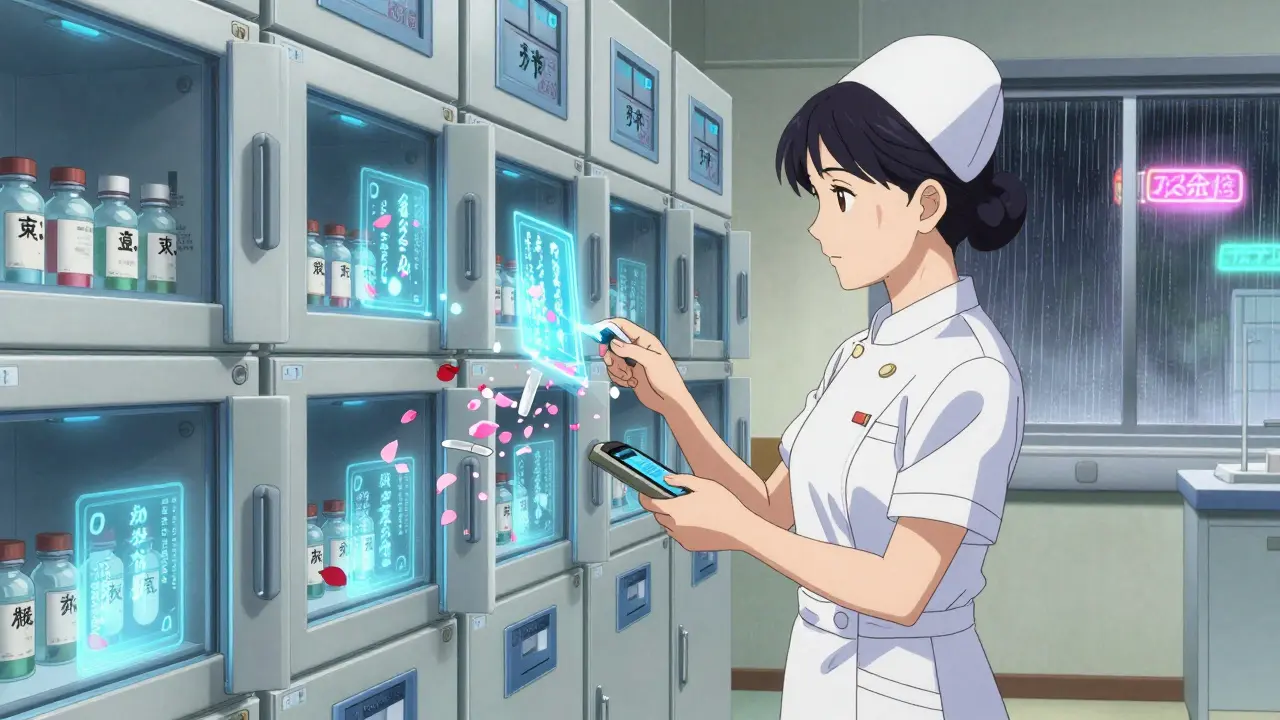
Automated Dispensing Cabinets (ADCs) in Hospitals
Closed-door pharmacies and hospital units use Automated Dispensing Cabinets are smart storage units that lock medications, log every access, record lot and expiration dates, and prevent dispensing of expired drugs. Common brands include BD Pyxis and Omnicell, used in over 70% of U.S. hospitals. These aren’t just fancy lockboxes-they’re intelligent systems. When a nurse pulls a vial of antibiotics, the cabinet doesn’t just record who took it. It checks the expiration date in real time. If the vial is expired, the cabinet won’t unlock. It’s a physical barrier to error. These cabinets also track how much is left, automatically triggering reorder alerts when stock runs low. That means fewer last-minute rushes and less chance of running out of critical meds during a code blue. TouchPoint Medical reports that staff in hospitals using ADCs take 40% less time managing medication inventory. The cabinets also reduce the risk of theft or misuse-especially for controlled substances like opioids.Mobile Apps for Emergency Services and Small Clinics
Not every provider has the budget for full RFID systems. That’s where mobile-first tools like LogRx is a medication tracking app for EMS and fire departments that runs on standard iOS and Android devices, using barcode scanning to log expiration dates and DEA-controlled substances. It’s used by Portland Fire & Rescue and EMS teams in the UK. No new hardware. No complex installation. Just download the app, scan the barcode on the medication, and the system records the expiration date. Emergency responders carry dozens of medications in their ambulances. A single expired epinephrine auto-injector could mean the difference between life and death. LogRx sends push notifications when a drug is within 30 days of expiring. Teams get reminders to replace it before their next shift. Portland Fire & Rescue reported a 60% reduction in expired medication incidents within six months of using LogRx.What You Need to Get Started
If you’re a hospital, clinic, or home care provider, here’s how to begin:- Assess your needs-Are you managing hundreds of medications daily? Do you have controlled substances? Are you in a regulated facility? This determines whether you need RFID, eMAR, ADCs, or just a mobile app.
- Choose the right system-RFID (KitCheck) for large hospitals. eMAR (eVero) for long-term care. ADCs for pharmacy-controlled units. LogRx for EMS and small clinics.
- Check compatibility-Make sure the system works with your existing electronic health records (EHR) and pharmacy software. Integration is key. Without it, you’ll have data silos.
- Tag your inventory-If using RFID, all medications need chips. This takes time. Mid-sized facilities may need 40-80 staff hours to tag everything. Some manufacturers now ship pre-tagged products.
- Train your team-Change is hard. Staff may resist new workflows. Offer hands-on training. Use vendor-provided guides. Most systems include 24/7 support.

Costs and ROI
RFID systems cost between $50,000 and $200,000 to install, depending on facility size. That sounds steep-but consider this: hospitals report saving $120,000 to $300,000 per year by cutting expired medication waste alone. Add in labor savings from faster inventory checks, and the ROI pays for itself in under a year. Mobile apps like LogRx cost under $5,000 per year for unlimited users. eMAR platforms range from $10,000 to $30,000 annually. These are affordable for small clinics and home care agencies. The global market for medication tracking is growing fast-projected to hit $5.1 billion by 2028. More than 45% of U.S. hospitals are expected to use RFID by then. The technology isn’t coming. It’s already here.What’s Next? AI and Blockchain
The next wave is smarter tracking. Companies like Intelliguard Health are testing AI that predicts when a medication is likely to expire based on usage patterns. Instead of waiting for a date to pass, the system tells you: "You’re using this insulin faster than average. You’ll run out in 12 days-order more now." Blockchain is being tested to track medications from manufacturer to patient. If a drug is recalled, the system instantly knows which patients received it-and which ones are at risk. These aren’t sci-fi ideas. They’re in pilot programs right now. And they’ll become standard within the next five years.Final Thoughts
You don’t need to be a hospital to benefit from this technology. Even if you’re managing a few prescriptions at home, there are apps that can help. Scan the barcode. Set a reminder. It’s that simple. The goal isn’t just to avoid expired meds. It’s to stop thinking about them altogether. Let technology do the remembering. Let it warn you. Let it replace what’s outdated. That’s not convenience-it’s safety.Can I use a smartphone app to track my personal medications’ expiration dates?
Yes. Apps like LogRx and Medisafe allow you to scan the barcode on your medication bottles and set expiration reminders. They send push notifications when a drug is about to expire. Some even sync with your pharmacy for automatic refill alerts. These are ideal for home use, especially if you take multiple medications daily.
Are RFID systems only for big hospitals?
No. While RFID is common in large hospitals, smaller clinics and even home care providers are adopting it. Some vendors offer scaled-down versions for 50-100 medication units. The key is whether you manage high-value or high-risk drugs-like insulin, epinephrine, or chemotherapy agents. If so, even a small RFID setup can save lives and money.
What happens if a medication expires but the system doesn’t alert me?
Most systems have multiple layers of protection. RFID and eMAR platforms trigger alerts at multiple thresholds-usually 30 days, 7 days, and 2 days before expiration. If you miss a notification, the system will still prevent dispensing if the drug is physically scanned after expiration. In ADCs and RFID cabinets, expired meds simply won’t unlock. Human error is reduced to near zero.
Do I need to replace all my medication labels?
Only if you’re using RFID. In that case, each package needs an RFID tag. Many manufacturers now ship medications pre-tagged. For barcode-based systems (like LogRx or eMAR), you just scan the existing barcode-no new labels needed. For home users, you don’t need to change anything-just use the app to scan and track.
Is this technology regulated by health authorities?
Yes. In the U.S., the Drug Supply Chain Security Act (DSCSA) and DEA regulations require accurate tracking of controlled substances. The FDA encourages automated expiration tracking to reduce patient harm. In New Zealand, the Ministry of Health recommends digital tracking for all high-risk medications in clinical settings. Using these systems helps you stay compliant with national and international standards.
How do I know if my pharmacy supports these systems?
Ask them. Most hospital pharmacies and large retail chains (like Pharmac in New Zealand) already integrate with eMAR and RFID platforms. If you’re using a mobile app like LogRx, you don’t need your pharmacy to do anything-you scan the bottle yourself. For eMAR, your provider must connect to the pharmacy’s system. If they don’t, they can usually set it up with vendor support.
Stacey Marsengill
January 17, 2026 AT 18:58I used to keep my meds in a shoebox labeled 'miscellaneous' until my aunt nearly died from a 2018 allergy pill. Now? I scan everything with Medisafe. It’s not just convenient-it’s the only thing keeping me alive. I don’t trust my memory. I don’t trust labels. I trust the app.
Aysha Siera
January 18, 2026 AT 15:27RFID chips in pills? Sounds like the government’s next step to track your body. Next they’ll implant microchips to monitor your cortisol levels. They don’t care if you live or die-they care if you’re compliant. This isn’t safety. It’s control.
rachel bellet
January 20, 2026 AT 12:27Let’s be clear: if you’re relying on a mobile app to manage your pharmaceutical inventory, you’re not managing anything-you’re outsourcing responsibility. Real clinical environments require validated, HIPAA-compliant, audit-trail-enabled systems. LogRx? That’s a glorified barcode scanner. It doesn’t integrate with EHRs, it doesn’t enforce chain-of-custody protocols, and it certainly doesn’t meet FDA 21 CFR Part 11 standards. If you’re using this in a clinical setting, you’re negligent.
And don’t get me started on the idea that 'home users' need this. If you can’t read a printed expiration date, you shouldn’t be self-administering prescription meds. This isn’t innovation-it’s infantilization of the patient population.
The real issue isn’t expiration tracking-it’s the erosion of basic health literacy. People can’t read. They can’t count. They can’t remember. So we build systems to compensate. That’s not progress. That’s systemic failure.
Meanwhile, hospitals are spending six figures on RFID when they could just hire a damn pharmacist. Or better yet-train their staff to do their jobs. Instead, we outsource cognition to machines and call it 'digital transformation.'
It’s not a solution. It’s a Band-Aid on a hemorrhage.
Pat Dean
January 22, 2026 AT 08:09Why are we letting foreign companies control our medication infrastructure? KitCheck? That’s a New Zealand product. eVero? Also overseas. We’ve got the best engineers in the world here in America-and we’re outsourcing our healthcare security to some startup in Auckland? This is why our supply chains are broken. If you’re serious about safety, you buy American. Period.
And don’t even get me started on the fact that these apps collect your data. Your meds. Your habits. Your health. Who owns that? Who’s selling it? You think Big Pharma doesn’t want to know when you stop taking your antidepressants? They do. And they’re using these apps to track you.
This isn’t progress. It’s surveillance dressed up as convenience.
Jay Clarke
January 24, 2026 AT 01:38Okay, but let’s be real-this whole thing is just a fancy way to make us feel like we’re doing something right while we’re still drowning in anxiety. I scanned my insulin bottle with LogRx and now I get a notification every time I breathe wrong. It’s not helping me live better-it’s making me paranoid. I used to just check the date. Now I’m checking my phone five times a day like some kind of digital junkie.
And don’t even get me started on the cost. $200k for RFID? Who’s paying for that? Medicare? My premiums are already through the roof. So now I’m paying for a system that tells me my pills are expired… while my rent goes up and my therapist bills me $200/hour?
We’re turning medicine into a tech support ticket. And it’s exhausting.
Selina Warren
January 24, 2026 AT 03:06This is the future-and it’s beautiful. Imagine a world where no one has to die because they didn’t know their EpiPen was old. Where a child with epilepsy doesn’t have a seizure because their meds were forgotten in a drawer. This isn’t tech for tech’s sake-it’s tech for LIFE.
Stop complaining about cost. Stop obsessing over privacy. What’s more important: your wallet or your child’s heartbeat? What’s more valuable: your data or your grandmother’s next breath?
I’ve seen people waste hundreds of thousands on bad decisions because they were too lazy to scan a barcode. This isn’t about convenience. It’s about dignity. It’s about respect-for the patient, for the caregiver, for the nurse who shows up at 3 a.m. to save someone’s life.
Don’t resist change. Embrace it. Because if you’re not part of the solution, you’re part of the problem. And right now? We’re losing people every day because we’re too scared to upgrade.
Tag your meds. Install the app. Train your team. Do it now. Not tomorrow. Not next year. NOW.
Because someone’s life? It’s not waiting.
Robert Davis
January 24, 2026 AT 06:54Interesting. But have you considered that RFID tags can be cloned? Or that the system might crash during a power outage? Or that someone could hack into the cloud and alter expiration dates? I’ve seen this before-back in 2016, a hospital in Ohio had a firmware bug that marked all insulin as expired. They had to recall 300 vials. Turned out it was just a timezone sync error.
Automation is great until it fails silently. And when it does? People die. And then you get lawsuits. And then you get audits. And then you get fired.
I’ve worked in pharmacy for 22 years. We used to use color-coded stickers. Simple. Reliable. No Wi-Fi needed. No cloud. No updates. No bugs.
Maybe we should stop trying to fix what isn’t broken.
Eric Gebeke
January 26, 2026 AT 03:52Let’s talk about the elephant in the room: pharmaceutical companies are pushing this because they want to make sure you keep buying their drugs. Why? Because if you know your meds are expired, you go back to the pharmacy. And guess what? They upsell you. New prescription. New bottle. New profit margin.
Meanwhile, the real problem is that drug prices are insane. You’re supposed to throw away $400 worth of insulin because it expired in July? That’s not a tech problem-that’s a corporate greed problem.
Why not fix the pricing? Why not make meds last longer? Why not regulate shelf life properly instead of creating a whole new industry to sell us apps and chips?
This isn’t saving lives. It’s just making the system more expensive.
Joni O
January 27, 2026 AT 07:53i just started using medisafe last month and honestly? it’s been a game changer. i have 7 different meds and used to mix them up all the time. now i get a little ping when it’s time and it even reminds me if i forget to take one. i’m not techy at all but the app is super simple. also, my mom uses it too and she’s 78. she says it feels like having a little nurse in her pocket. 🥹
also, i scanned my old ibuprofen and it told me it expired in 2021. i threw it out. felt so good. no more guessing.
Ryan Otto
January 27, 2026 AT 11:13While the technological solutions presented are superficially compelling, they represent a profound epistemological regression. The reliance on algorithmic notification systems supplants the epistemic authority of the clinician and the patient’s embodied knowledge of their own physiology. One cannot outsource pharmacological responsibility to a machine without eroding the very foundation of medical autonomy.
Moreover, the proliferation of proprietary, vendor-locked platforms creates dangerous monocultures in pharmaceutical logistics. The dependency on UHF RFID and closed-loop EHR integrations renders institutions vulnerable to single-point failures-a single server breach, a firmware update, or a licensing fee increase can collapse an entire medication management ecosystem.
This is not innovation. It is commodification of safety under the guise of progress.
Max Sinclair
January 27, 2026 AT 19:58Really appreciate this breakdown. I’ve been using LogRx for my EMS kit for a year now and it’s cut our expired meds down to almost zero. No drama, no panic, just a quiet notification on my phone before shift. I love that it’s simple and doesn’t need a PhD to use.
Also, big thanks for mentioning the DSCSA and FDA stuff-most people don’t realize this isn’t just ‘nice to have,’ it’s the law. We’re not just being careful-we’re being legal.
And to everyone saying ‘it’s too expensive’ or ‘it’s surveillance’-try living with the guilt of giving someone expired medicine. Then come back and talk.