
Lithium Carbonate Generics: What You Need to Know About Serum Levels
When you’re taking lithium carbonate for bipolar disorder, the brand on the bottle shouldn’t matter - or so you’d think. But in reality, switching from one generic version to another can change your blood levels enough to trigger side effects or make your mood unstable. This isn’t about quality. It’s about lithium carbonate being one of the most sensitive drugs in medicine. Even tiny differences in how it’s made can shift how much gets into your bloodstream.
Why Lithium Is Different From Other Medications
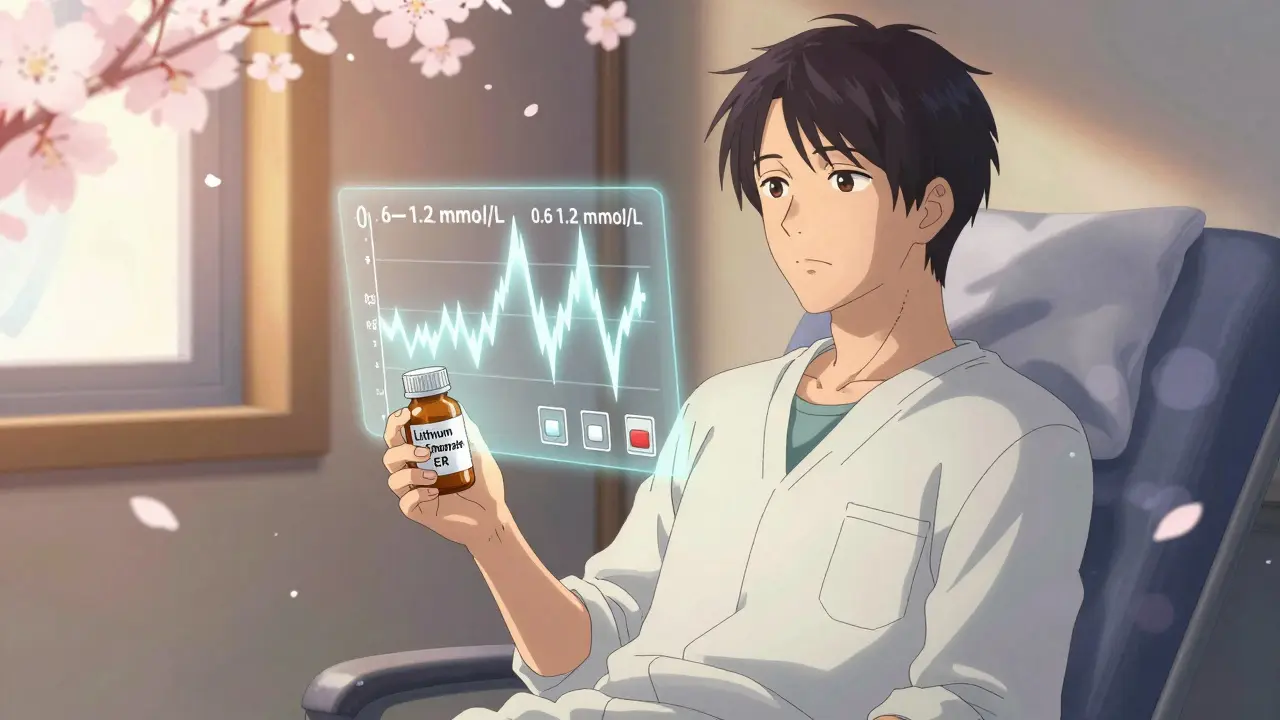
Lithium isn’t like antibiotics or blood pressure pills. Most drugs have a wide safety zone. You can take a little more or less and nothing major happens. Lithium doesn’t work that way. Its therapeutic range is razor-thin: between 0.6 and 1.2 mmol/L. Go below 0.6, and it might not control your mood swings. Rise above 1.2, and you risk tremors, confusion, or worse - seizures, kidney damage, even heart rhythm problems. At 1.5 mmol/L or higher, lithium becomes dangerous. At 2.0 mmol/L, it can be life-threatening. This narrow window is why doctors don’t just prescribe a standard dose and call it done. Every patient needs regular blood tests. And when you switch from one generic lithium brand to another - say, from Priadel to Camcolit - your doctor needs to check your levels again. Why? Because even if both pills contain the same amount of lithium carbonate, they release it into your body differently.How Different Generics Work
Not all lithium carbonate generics are created equal. Some are immediate-release. Others are extended- or controlled-release. That difference changes everything. Immediate-release forms (like some versions from Essential Pharma) hit your bloodstream fast. You feel the peak effect in 1 to 2 hours. That means you usually need to take them three times a day to keep levels steady. But the highs and lows between doses can be sharp. Some people get nausea or diarrhea because of those spikes. Sustained-release versions - like Priadel or Camcolit - spread the dose out over 4 to 5 hours. That means fewer daily doses (often just once or twice a day), smoother blood levels, and fewer stomach issues. But here’s the catch: because they release slowly, your body absorbs them differently. A 2024 study found that when patients switched from Priadel to Camcolit, their average serum lithium levels jumped by 11%, even when the daily dose stayed the same. That’s not a small difference. That’s enough to push someone from a safe level into the danger zone. And it’s not just brand names. Even two generics labeled “lithium carbonate ER” can behave differently. One might release 80% of its lithium over 4 hours. Another might release only 65%. The total amount absorbed might be similar, but the timing changes how your brain and kidneys handle it.What Your Blood Test Really Tells You
When your doctor orders a lithium level test, they’re not just checking if you’re “in range.” They’re checking if your body is handling the specific pill you’re taking. For immediate-release lithium, blood is drawn 12 hours after your last dose. That’s when levels stabilize. For sustained-release versions, the timing shifts. If you take it once daily, the test is done 24 hours after your last dose. If you’re on twice-daily dosing, the timing depends on your regimen. And here’s something many patients don’t realize: your lithium level isn’t just about the pill. It’s also about your kidneys. Lithium is cleared through your kidneys. If you’re dehydrated - from sweating too much, skipping water, or getting sick with diarrhea or vomiting - your levels can spike. That’s why doctors always check your creatinine and eGFR. If your kidney function drops even a little, your lithium dose may need to come down. Thyroid function matters too. About 1 in 10 people on long-term lithium develop hypothyroidism. That’s why TSH levels are checked every 6 to 12 months. If your thyroid slows down, you might feel tired, gain weight, or get depressed - symptoms that could be mistaken for bipolar relapse.
Who Needs Extra Caution
Not everyone handles lithium the same way. People over 60 are at higher risk. Kidneys slow down with age. A 70-year-old might need 30% less lithium than a 30-year-old. Some experts recommend target levels of 0.4-0.6 mmol/L for older adults, not the standard 0.6-0.8 mmol/L. But many doctors still use the same targets - and that’s where problems start. Women, on average, need slightly lower doses than men. A 2024 study found women took 96 mg less lithium per day than men, even after adjusting for weight and other factors. That’s likely because women have more body fat and less muscle mass, which affects how lithium distributes in the body. And then there’s genetics. Researchers have found at least 30 gene variants that affect how people respond to lithium. Some people naturally clear it faster. Others hold onto it longer. This is why two people on the same dose can have wildly different blood levels. Right now, we don’t test for these genes routinely - but that’s changing. Clinical trials are testing AI tools that use your age, weight, kidney function, and genetic data to predict your ideal dose.What Happens When You Switch Brands
Pharmacists often substitute generics to save money. That’s legal. But with lithium, it’s risky. In one real case, four patients had dangerously high lithium levels - 1.32, 1.32, 1.88, and 1.35 mmol/L - after their pharmacy switched them from one generic to another without telling their doctor. One had tremors. Another got confused. One needed hospitalization. Even if your doctor doesn’t know you switched brands, your blood level will. That’s why you must tell your prescriber if your pharmacy changes your pill. Never assume it’s the same. Always ask: “Is this the same formulation I was on?” If you’ve been stable on a specific brand - even if it’s generic - stick with it. Don’t let a pharmacy switch you without your doctor’s approval. If your insurance forces a change, ask for a prior authorization to keep your current version.
What’s the Right Level for You?
There’s no single answer. It depends on your diagnosis, your age, your kidney health, and your formulation. For acute mania: 0.8-1.0 mmol/L For long-term maintenance: 0.6-0.8 mmol/L For sustained-release formulations: aim for the upper end of that range - 0.8 mmol/L - because they release slower For older adults: 0.4-0.6 mmol/L is often safer The American Psychiatric Association updated its guidelines in 2021 to reflect this. But many doctors still default to 0.8-1.0 mmol/L for everyone. That’s outdated. Your doctor should adjust based on your situation.What You Can Do
You’re not powerless here. Here’s what actually works:- Always know which generic you’re taking. Write down the name on the bottle - Priadel, Camcolit, Essential Pharma, etc.
- Never let your pharmacy switch your brand without telling your doctor.
- Get your blood drawn at the same time of day, and always after 12 or 24 hours since your last dose - depending on your formulation.
- Drink water. Don’t skip meals. Avoid excessive caffeine or alcohol. These throw off your levels.
- Ask for a TSH and eGFR test every 6 months. Don’t wait until you feel bad.
- If you start feeling shaky, confused, or nauseous, get your level checked immediately.
Steven Lavoie
December 17, 2025 AT 11:46It’s wild how something so old-school like lithium still demands this level of precision in 2024. I’ve been on it for eight years, and the moment my pharmacy switched me from Priadel to a no-name generic, I started getting hand tremors at 3 a.m. No one warned me. I thought it was stress. Turned out my level jumped to 1.3. They had to admit: even ‘equivalent’ generics aren’t.
Doctors need to treat lithium like insulin-no substitutions without retesting. Period.
Raven C
December 17, 2025 AT 19:11How utterly predictable-another post from the ‘lithium is sacred’ cult. Honestly, the entire therapeutic window argument feels like medical mysticism. If your body can’t handle a 0.2 mmol/L fluctuation, perhaps you’re not suited for pharmacological intervention at all.
Modern psychiatry is over-reliant on this 1950s relic. Why not just embrace lamotrigine or ketamine? The fact that we’re still micromanaging serum levels like we’re piloting a rocket to Mars is frankly embarrassing. Lithium’s time is over.
Sachin Bhorde
December 19, 2025 AT 16:33Bro, this is real. I’m a med student in Bangalore and we had a case last month-old guy, 72, on lithium for 15 years. Switched from Camcolit to some Indian generic, didn’t tell doc. Ended up in ICU with delirium and creatinine at 2.1.
Point is: lithium ain’t like ibuprofen. Even the ‘ER’ label is misleading. Some generics release like a firehose, others like a dripping tap. Docs forget that. Pharmacies don’t care. Patients? They just want the copay to be low.
TL;DR: Know your pill. Write the name down. Ask for prior auth. Your brain will thank you.
Naomi Lopez
December 21, 2025 AT 15:04It’s fascinating how people treat lithium like it’s some kind of magical elixir when it’s really just a salt. The fact that we still use it is less about efficacy and more about inertia.
And yet-everyone’s so scared to challenge it. ‘Oh no, the suicide risk!’ But we’re not even talking about optimal dosing. We’re talking about placebo-level precision in a world of precision medicine. It’s absurd.
Salome Perez
December 23, 2025 AT 12:42Thank you for writing this with such care and clarity. As someone who’s lived with bipolar disorder for over two decades, I can’t tell you how many times I’ve been told, ‘It’s just lithium-it’s the same.’
It’s not. I’ve been on Priadel since 2016. My levels are rock-solid. When my insurance tried to switch me to a ‘generic equivalent,’ I fought back. I printed out the 2024 study you cited. I called my doctor. I sent my pharmacist a PDF of the FDA’s warning on lithium interchangeability.
They backed down.
You’re not being difficult-you’re being smart. And you’re not alone. Please keep speaking up. Your voice helps people like me stay safe.
Josh Potter
December 25, 2025 AT 09:24Y’all are overthinking this. I’ve been on lithium for 12 years. Switched generics five times. Still fine. Drink water, don’t chug coffee, get your blood drawn, done.
Stop treating your meds like they’re made of glass. If your doc’s good, they’ll catch it. If they’re not? Fire ‘em. Lithium’s not magic. It’s chemistry. And you’re not a lab rat.
Victoria Rogers
December 25, 2025 AT 21:33Who approved this? The FDA? The AMA? The pharmaceutical lobby? Because this whole ‘lithium is special’ narrative smells like a scam to keep people dependent on outdated, cheap drugs while they charge $400 for a new ‘innovative’ mood stabilizer.
It’s not about safety. It’s about control. And if you’re not asking who profits from this, you’re not thinking critically.
Jody Patrick
December 27, 2025 AT 05:44Switch brands, get tested. That’s it. No drama. No drama.
Jonathan Morris
December 29, 2025 AT 01:48Did you know the original lithium patents were held by a company that later became part of a defense contractor? And that the NIH funded early lithium trials during the Cold War because they were studying ‘chemical control of behavior’ in prisoners?
There’s a reason the therapeutic window is so narrow. It’s not an accident. It’s by design. They want you dependent. They want you monitored. They want you afraid to change.
That’s not medicine. That’s social engineering. And now they’ve got you scared of generics. Funny how that works, isn’t it?