
Multiple Sclerosis: Understanding Neurological Deterioration and How Disease-Modifying Therapies Work

Multiple sclerosis isn’t just about flare-ups and fatigue. For many people, the real battle begins long after the last relapse fades - in the quiet, invisible damage inside the brain and spinal cord. While inflammation gets all the attention, it’s the neurological deterioration - the slow, steady loss of nerve fibers - that leads to lasting disability. And here’s the hard truth: current treatments don’t stop it.
What’s Actually Happening Inside the Nervous System?
Multiple sclerosis starts with the immune system attacking the myelin sheath - the fatty insulation around nerve fibers in the brain and spinal cord. When myelin breaks down, electrical signals slow down or get blocked. That’s why you might lose vision, feel numbness, or struggle to walk during a relapse. But here’s what most people don’t realize: the damage doesn’t stop there. Under the microscope, scientists see something worse: axons - the long, wire-like parts of nerve cells - begin to fray, swell, and die. These aren’t just damaged by inflammation. They’re starving. Studies show that in chronic MS lesions, up to 50% of demyelinated axons have fewer mitochondria, the energy factories cells need to survive. Without myelin, axons use up to 10 times more energy to send signals. Over time, they burn out. This isn’t temporary. Unlike inflammation, which can heal, axonal loss is permanent. Once a nerve fiber dies, it doesn’t grow back in the central nervous system. That’s why someone who had a good recovery after their first relapse might still end up needing a cane 10 years later. The damage isn’t from the flare-up - it’s from what happened afterward.The Three Faces of MS: Relapsing, Progressive, and the Hidden Shift
Most people are diagnosed with relapsing-remitting MS (RRMS). About 85% of cases start this way - sudden attacks, then periods of stability. Drugs like interferons, fingolimod, or ocrelizumab can cut relapses by 30-50%. But these medications only target the immune system’s fire. They don’t fix the burning wires. Over time, many people with RRMS shift into secondary progressive MS (SPMS). This isn’t a new diagnosis - it’s a progression. The relapses become less frequent, but the decline continues. MRI scans show fewer new lesions. Blood tests show less inflammation. Yet, the person keeps losing function. Why? Because the damage has moved inside the nervous system itself. In SPMS, inflammation doesn’t vanish - it changes. Instead of immune cells flooding in from the bloodstream, they gather in the meninges, the membranes covering the brain. Here, B cells form clusters like tiny immune factories, releasing toxins that slowly poison nearby nerves. This is why drugs that work in RRMS often fail in SPMS. They’re designed to block immune cells from entering the brain. But in progressive MS, the damage is already inside. And then there’s primary progressive MS (PPMS), affecting about 15% of patients from the start. No relapses. No remissions. Just steady decline. For these individuals, neurodegeneration is the main driver - not inflammation. Current disease-modifying therapies have barely any effect on PPMS.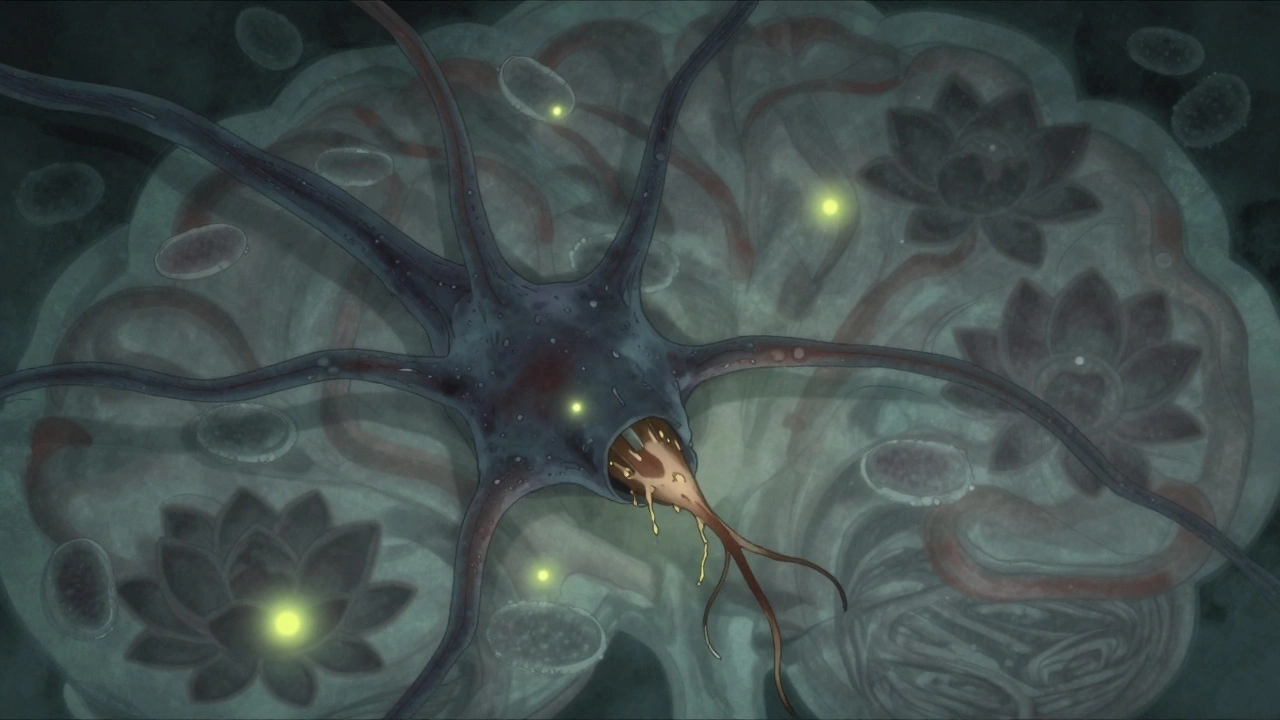
Why Disease-Modifying Therapies Fall Short
There are 21 FDA-approved disease-modifying therapies (DMTs) for MS. Each one targets a different part of the immune system. Some deplete B cells. Others trap immune cells in lymph nodes. Some block molecules that let immune cells cross into the brain. They work - for relapses. They reduce new lesions on MRI. They lower hospital visits. But they don’t stop brain shrinkage. They don’t slow the loss of gray matter. They don’t preserve walking ability long-term. A 2023 study found that brain volume loss - especially in the gray matter - predicted disability progression better than relapse rates or lesion counts. That’s the real warning sign. And no current DMT is approved specifically to protect axons or rebuild myelin. This creates a cruel gap: patients are told their treatment is working because their MRI looks better - but their legs still feel heavier, their balance worse, their memory slipping. The treatment is doing its job - just not the job that matters most for long-term quality of life.What’s Next? The New Frontiers in MS Treatment
Scientists are no longer just fighting inflammation. They’re trying to save nerves. One promising path is targeting mitochondrial failure. If axons are running out of energy, can we give them more? Trials are testing drugs that boost mitochondrial function - like ibudilast, which showed signs of slowing brain atrophy in a 2021 phase II trial. Another approach focuses on sodium channels. After demyelination, axons overwork to keep signals going. This floods them with sodium, which triggers toxic reactions. Drugs like phenytoin and siponimod are being tested to block these channels and reduce axonal stress. Remyelination is the holy grail. Can we get the body to regrow myelin? Experimental drugs like opicinumab and clemastine are trying to wake up the brain’s own repair cells - oligodendrocyte precursor cells. Early results are mixed, but the idea is clear: if we can remyelinate axons, we might restore function and prevent degeneration. Even the immune system is being rethought. Instead of just suppressing it, researchers are exploring ways to make it protective. Some studies suggest certain immune cells can actually support nerve repair. The goal isn’t to shut down immunity - it’s to retrain it.
Saurabh Tiwari
December 3, 2025 AT 12:24Kristen Yates
December 5, 2025 AT 01:26Paul Santos
December 6, 2025 AT 21:02Sheryl Lynn
December 8, 2025 AT 10:44Chris Wallace
December 10, 2025 AT 04:26John Morrow
December 10, 2025 AT 08:00Shubham Pandey
December 11, 2025 AT 18:03Elizabeth Farrell
December 13, 2025 AT 10:11Sandi Allen
December 13, 2025 AT 14:57John Webber
December 13, 2025 AT 19:43