
Pediatric Vision Screening: How Early Detection Prevents Lifelong Vision Problems
Every year, thousands of children in the U.S. grow up with undiagnosed vision problems that could have been fixed easily-if only someone had looked. By age 5, a child’s visual system is nearly fully developed. After that, it becomes much harder to correct issues like lazy eye or crossed eyes. That’s why pediatric vision screening isn’t just a checkmark on a wellness visit-it’s a critical window to prevent permanent vision loss.
Why Screening Before Age 5 Matters
The human eye doesn’t just need to see clearly-it needs to learn how to see. From birth to age 7, the brain is wiring itself to interpret what the eyes send. If one eye is blurry, misaligned, or blocked, the brain starts ignoring it. That’s amblyopia, or lazy eye. It’s not a problem with the eye itself. It’s a problem with the brain’s connection to the eye.Studies show that when amblyopia is caught before age 5, 80 to 95% of children can regain normal vision with treatment. But if it’s missed until after age 8, success rates drop to just 10 to 50%. That’s not a small difference. That’s life-changing.
Strabismus-where eyes point in different directions-affects nearly 2 in every 100 children. Refractive errors like nearsightedness or astigmatism are even more common. Left untreated, these conditions don’t just affect school performance or sports. They can lead to lifelong visual impairment.
How Screening Works by Age
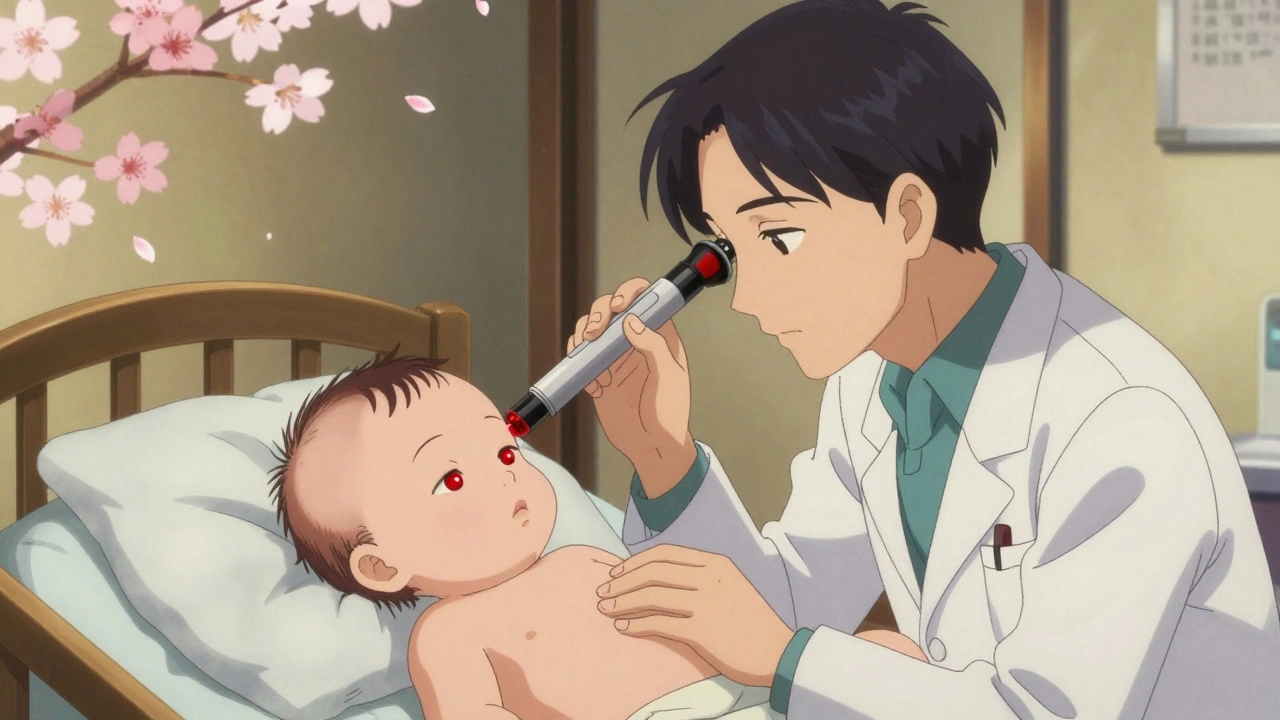
Pediatric vision screening isn’t one-size-fits-all. The method changes as kids grow.For babies (0-6 months): Doctors check the red reflex using a small light tool. A healthy eye reflects a bright red glow. If one eye looks dark or white, it could mean a cataract, tumor, or retinal problem. This test takes seconds but catches serious issues early.
For toddlers (6 months-3 years): Screening includes checking eye movement, pupil response, and eyelid health. No charts yet. Instead, providers watch how the child tracks objects or reacts to light. If a child doesn’t follow a toy with both eyes, that’s a red flag.
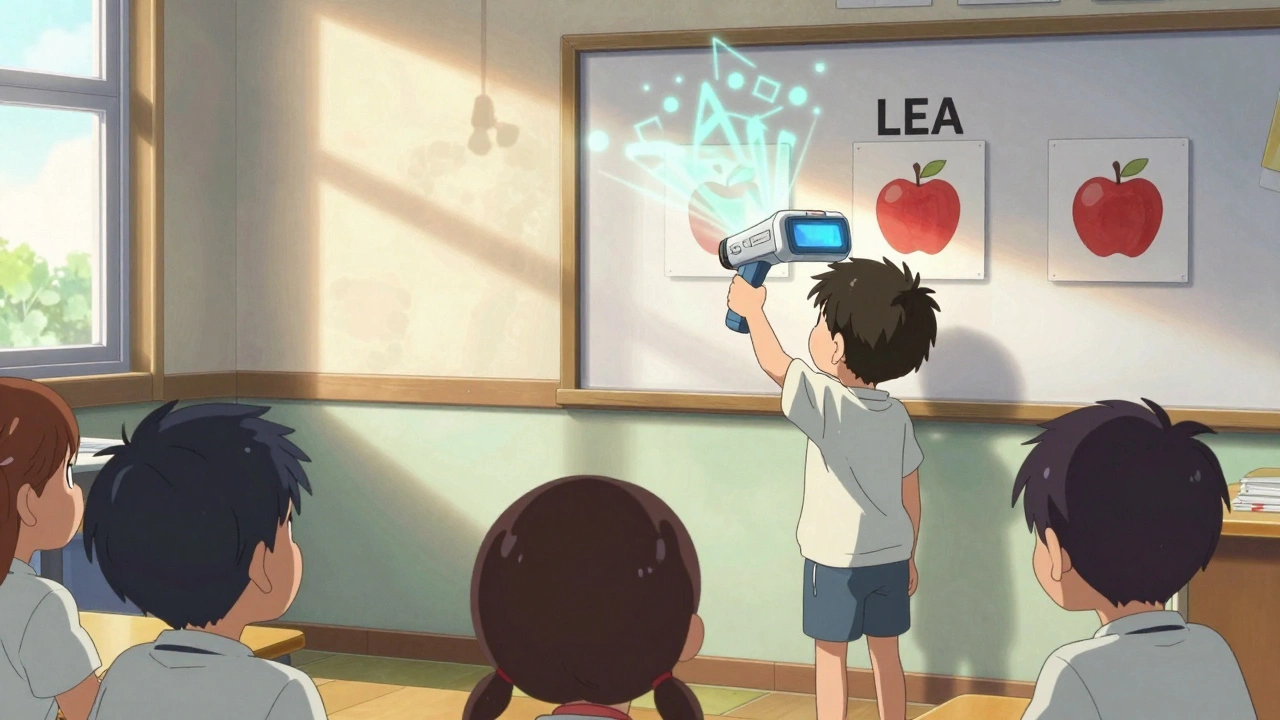
For children 3-5 years: This is the critical window. Most guidelines now recommend using either eye charts or instrument-based screening. For charts, kids identify shapes or letters from 10 feet away. The LEA symbols (circles, squares, apples, houses) or HOTV letters are used because young kids don’t know the alphabet yet. At age 3, they need to read the 20/50 line. At age 4, it’s 20/40. By age 5, it’s 20/32 or better.
But not all kids cooperate. That’s where tools like the SureSight or blinq™ scanner come in. These devices shine a light into the eye and measure how light bends as it passes through. In under a minute, they detect refractive errors, misalignment, or asymmetry between eyes. The blinq™ scanner, cleared by the FDA in 2018, caught 100% of referral-worthy cases in a 2022 study of 200 children.
Instrument-Based vs. Chart-Based Screening
There’s been a quiet revolution in how kids’ vision is checked.Traditional eye charts are still the gold standard for kids who can cooperate. But they fail in 10 to 25% of 3- and 4-year-olds simply because the child won’t sit still, doesn’t understand the task, or gets distracted.
Instrument-based tools don’t need the child to say anything. They just need to look at a light. That makes them ideal for preschools, pediatric clinics, and even home visits. They’re faster-1 to 2 minutes per child-and more consistent. One 2023 study found they had a 68% positive predictive value compared to 52% for chart tests in children under 5.
But they’re not perfect. They can flag kids with mild refractive errors that don’t need glasses. That leads to unnecessary referrals. And they’re expensive: devices like the SureSight cost $5,500 to $7,000. The blinq™ scanner is cheaper at around $3,500, making it more accessible for smaller clinics.
Experts agree: use instrument-based screening for kids who can’t do charts. But for those who can, stick with LEA or HOTV. Don’t rely on Snellen charts until age 6 or 7-kids don’t know the letters yet.
Who Should Be Screened and When
Guidelines are clear: every child needs screening.The U.S. Preventive Services Task Force recommends at least one screening between ages 3 and 5. The American Academy of Pediatrics adds screenings at ages 8, 10, 12, and 15. But here’s the catch: many kids never get screened at all.
Studies show Hispanic and Black children are 20 to 30% less likely to receive recommended vision screening. That’s not because parents don’t care. It’s because access is uneven. School-based screenings help, but only 38 states require them-and standards vary wildly.
That’s why pediatricians are the frontline. Vision screening should be part of every well-child visit from age 1. The AAP now recommends instrument-based screening starting at age 1, even before kids can read a chart. It’s not about catching amblyopia yet-it’s about catching risk factors early.
And it works. The economic value is clear. The USPSTF found every dollar spent on pediatric vision screening saves $3.70 in lifetime costs-from lost productivity to special education needs to surgery.
What Happens After a Positive Screen
A failed screen isn’t a diagnosis. It’s a referral.When a child doesn’t pass, the next step is a full eye exam by a pediatric ophthalmologist or optometrist. That’s where things get real. They’ll dilate the eyes, check for cataracts, test depth perception, and measure eye pressure. They’ll confirm whether it’s amblyopia, strabismus, or just a need for glasses.
Treatment isn’t complicated. For amblyopia, it’s usually patching the stronger eye for a few hours a day. Sometimes it’s eye drops that blur the good eye. For strabismus, glasses, vision therapy, or surgery may be needed. Most kids respond within months.
But delay? That’s dangerous. The longer treatment waits, the less effective it becomes. A child who gets glasses at age 4 might see perfectly by age 6. One who waits until 10 might never reach 20/20 vision.
Common Pitfalls and How to Avoid Them
Even with good tools, mistakes happen.One of the biggest errors? Testing at the wrong distance. If the chart is too close, kids guess. Too far, and they can’t see. The 10-foot rule isn’t optional. A 2018 study found 25% of screenings failed because the chart wasn’t properly positioned.
Another? Poor lighting. A dimly lit room makes charts unreadable. Use a bright, even light source. No shadows.
And don’t screen both eyes at once. Always cover one eye at a time. Kids will cheat. They’ll use the good eye to guess. That gives false reassurance.
Training matters too. Providers need 2 to 4 hours of hands-on practice to get it right. Free training modules from the National Center for Children’s Vision and Eye Health have been used by over 15,000 professionals since 2016. Use them.
The Future of Pediatric Vision Screening
The field is evolving fast.AI-powered devices like blinq™ are just the beginning. Researchers are now testing screening tools on infants as young as 9 months. Early results from JAMA Pediatrics (2022) show it’s possible-and effective.
The National Eye Institute is funding $2.5 million in research to improve screening in underserved communities. That’s crucial. Right now, disparities in access are a public health crisis.
By 2025, the AAP is expected to update its guidelines to recommend screening starting at age 1 with instrument-based tools for all children, not just those at risk. That’s a big shift. But it’s the right one.
What’s clear: pediatric vision screening isn’t optional. It’s essential. And it’s not just about seeing letters on a chart. It’s about giving every child a chance to see the world clearly-before it’s too late.
What is the most common vision problem in children?
The most common vision problem in children is amblyopia, or lazy eye. It affects 1.2% to 3.6% of children. Strabismus (crossed eyes) is the second most common, affecting about 1.9% to 3.4%. Both can be corrected if caught early, usually before age 5.
Can a child pass a school vision screening and still have a problem?
Yes. School screenings are often basic and may only test distance vision. A child might have perfect distance vision but struggle with near vision, eye teaming, or depth perception-all of which affect reading and learning. A full eye exam by an eye doctor is the only way to catch all issues.
How often should my child get their eyes checked?
The American Academy of Pediatrics recommends vision screening at ages 1, 3, and 5, then again at 8, 10, 12, and 15. If your child has a family history of eye problems, was born prematurely, or has developmental delays, more frequent checks may be needed. Always follow your pediatrician’s advice.
Are vision screenings covered by insurance?
Yes. Under the Affordable Care Act, pediatric vision screening is an essential health benefit. Most insurance plans, including Medicaid, cover it as part of well-child visits. Some states also require insurers to cover full eye exams if a screening fails.
What if my child refuses to cooperate during screening?
That’s common, especially in 3- and 4-year-olds. Use instrument-based screening tools like the blinq™ or SureSight, which don’t require verbal responses. If those aren’t available, try again in a few weeks. Don’t give up. A failed screen isn’t a failure-it’s a signal to try again or refer.
michael booth
December 4, 2025 AT 23:43Every child deserves a clear view of the world. This post nails why early screening isn't optional-it's foundational. I've seen too many kids struggle in school because no one checked their vision until it was too late. A simple 2-minute scan at age 1 could change their entire trajectory.
Let’s make this standard in every pediatric visit. No exceptions.
Carolyn Ford
December 5, 2025 AT 13:35Oh, please. You’re acting like this is some revolutionary breakthrough. Kids have been getting their eyes checked for decades. The real issue? Overmedicating, overdiagnosing, and turning every minor refractive error into a ‘public health crisis.’
My son passed every ‘screening’-and still needed glasses at 6. So what? He’s fine. Stop scaring parents into thinking every blink is a sign of doom.
Alex Piddington
December 7, 2025 AT 04:04As a pediatric nurse, I’ve used both chart and instrument-based tools. The blinq™ scanner is a game-changer for toddlers who won’t sit still. One mom told me her 2-year-old cried during the chart test-then giggled at the blinq™ because it looked like a spaceship.
But let’s not pretend tech replaces training. A poorly calibrated device gives false confidence. Proper training matters more than the tool itself.
Dematteo Lasonya
December 7, 2025 AT 23:52My daughter failed her preschool screening. We thought it was just stubbornness. Turns out she had severe astigmatism in one eye. Patching for three months and now she reads chapter books like it’s nothing.
This isn’t about fear. It’s about fairness. Every kid, regardless of zip code, deserves the same shot at seeing clearly. If we can screen for hearing, why not vision? It’s basic.
Rudy Van den Boogaert
December 9, 2025 AT 16:52I work in a rural clinic. We don’t have a SureSight. We use a $150 handheld refractor and a laminated LEA chart taped to the wall.
It’s not perfect. But we screen every kid at 3 and 5. Parents bring them in because we explain it simply: ‘If they can’t see the board, they can’t learn.’ No jargon. No panic. Just facts.
And yes, we’ve caught cataracts. Once. That one kid? Now he’s in first grade. Seeing everything.
Gareth Storer
December 10, 2025 AT 18:12So let me get this straight. We’re now supposed to scan babies’ eyes like they’re barcodes? Next they’ll be doing DNA tests at the nursery.
Meanwhile, actual problems-malnutrition, lead exposure, lack of sleep-are being ignored because we’re too busy chasing ‘referral-worthy’ astigmatism.
It’s not screening. It’s performance.
Pavan Kankala
December 12, 2025 AT 13:18Who benefits from this? The eye industry. The device manufacturers. The ‘experts’ selling training modules.
Did you know the American Academy of Pediatrics gets funding from lens companies? Coincidence? I think not.
My cousin got glasses at 2. Now he’s 18 and can’t see without them. Was that prevention? Or just profit-driven dependency?
They say ‘80-95% success rate.’ But what’s the long-term data? No one talks about that.
Jessica Baydowicz
December 14, 2025 AT 03:39OMG I just cried reading this. My little guy was diagnosed with lazy eye at 4-thanks to his daycare’s screening. We thought he was just squinting because he was tired. Nope. Patching every day felt like a battle… until he started recognizing his favorite cartoon characters on the TV.
Now he’s 7 and draws dragons with perfect perspective. I’ll never stop thanking that nurse who didn’t let us brush it off.
Parents-don’t wait. Don’t assume. Just. Do. The. Screen.
Yasmine Hajar
December 15, 2025 AT 15:11In my community, we’ve partnered with local churches and libraries to host free vision pop-ups. We use the blinq™ scanner. Parents bring snacks. Kids get stickers. It’s not clinical-it’s community.
One grandma told me, ‘I never knew my grandson couldn’t see the birds outside.’ Now he’s drawing them. Every color. Every wing.
This isn’t medicine. It’s magic.
And it’s free. If we can find the will, we can find the way.
Karl Barrett
December 17, 2025 AT 09:05The neuroplasticity window for visual cortical development is indeed constrained, with critical periods terminating around age 7–8, as evidenced by fMRI studies on ocular dominance columns.
Instrument-based screening leverages photorefraction and wavefront analysis to detect anisometropia and strabismus with high sensitivity, circumventing the confounding variable of behavioral compliance.
However, the positive predictive value remains suboptimal without confirmatory cycloplegic refraction-a gold standard often inaccessible in primary care due to resource constraints.
Thus, the policy imperative must be tiered: population-level screening, followed by equitable access to subspecialty diagnostics.
Jake Deeds
December 18, 2025 AT 16:29Of course you’re pushing this. Because if we just let kids be kids, maybe they’d grow up without needing glasses. But no-let’s turn every child into a medical case study.
My grandfather never had his eyes checked. Saw the stars, read the Bible, fixed tractors. Now we’re scanning infants like they’re defective products.
What happened to just letting people see the world as it is?
Oh right. Profit. And fear. And overmedication.
It’s all so… exhausting.
Elizabeth Crutchfield
December 20, 2025 AT 05:24Ben Choy
December 21, 2025 AT 19:11Just had my nephew screened at his pediatrician. Used the blinq™. Took 45 seconds. He didn’t even notice.
Turns out he’s got a slight refractive error. Glasses will fix it. No patching. No drama.
My sister was in tears. Not from stress-from relief.
Thank you for writing this. I’m sharing it with every parent I know.
❤️