
Timing Medications to Prevent Drug Interactions and Side Effects

Imagine taking your blood pressure pill at breakfast, your thyroid medicine at noon, and your calcium supplement at dinner - all on the same day. Sounds simple, right? But what if one of those pills stops another from working? Or makes you feel sick? That’s not rare. In fact, drug interactions are one of the top reasons people end up in the hospital, and a huge chunk of them can be avoided with one simple trick: timing.
Why Timing Matters More Than You Think
Most people think drug interactions mean two pills cancel each other out - like mixing alcohol and antibiotics. But that’s only part of the story. There’s another kind of interaction that doesn’t show up on most warning labels: time-dependent drug interactions (TDDIs). These happen when two drugs are taken too close together, and one blocks the other from being absorbed properly. The result? Your medicine doesn’t work like it should. Take ciprofloxacin, an antibiotic used for infections. If you take it with an antacid like Tums or Maalox - even just an hour apart - your body absorbs up to 90% less of the antibiotic. That means the infection might not clear up. But if you wait two hours after the antacid, the antibiotic works fine. No dose change. No switch. Just timing. Same goes for levothyroxine, the common thyroid pill. If you take it with iron, calcium, or even coffee within four hours, absorption drops to 50% or lower. That’s not just inconvenient - it can make you tired, gain weight, or feel depressed because your thyroid isn’t getting the support it needs. The fix? Take it first thing in the morning, on an empty stomach, and wait at least 30 to 60 minutes before eating or taking anything else. For iron or calcium supplements, wait four full hours.Common Medications That Need Space
Not all drugs play nice together. Some are picky about who they hang out with - and when. Here are the big ones you need to watch:- Antibiotics (tetracycline, doxycycline): Don’t take them with dairy, antacids, or iron. Wait 2-3 hours. Calcium binds to these antibiotics like glue.
- Bisphosphonates (alendronate, risedronate): Used for osteoporosis. Must be taken with a full glass of water, 30 minutes before food or other meds. Lie down after? That’s a no. You risk serious esophageal damage.
- Levothyroxine: Needs 4 hours before calcium, iron, magnesium, or soy products. Even some fiber supplements can interfere.
- Proton pump inhibitors (PPIs like omeprazole): Reduce stomach acid, which can mess with absorption of drugs like ketoconazole or iron. Space them 2+ hours apart from other meds if possible.
- Cholesterol drugs (statins like simvastatin): Grapefruit juice isn’t the only problem. Some antifungals and antibiotics can spike statin levels dangerously. Timing doesn’t fix this - you need a different drug.
What Timing Can’t Fix
Here’s the hard truth: not all interactions can be solved by waiting. Some happen inside your liver, where enzymes break down drugs. If one drug slows down how fast your body processes another, spacing them out won’t help. Take warfarin (a blood thinner) and metronidazole (an antibiotic). Metronidazole blocks the enzyme that breaks down warfarin. So even if you take them 6 hours apart, warfarin builds up in your blood. That raises your risk of dangerous bleeding. The fix? Not timing. It’s either switching antibiotics or lowering the warfarin dose under close monitoring. Same with some antidepressants and painkillers. Mixing SSRIs with tramadol can cause serotonin syndrome - a life-threatening spike in brain chemicals. No amount of spacing will prevent that. You need to avoid the combo entirely. Timing works best when the problem is in your gut - absorption. Once the drug enters your bloodstream, it’s too late to fix the interaction with a clock.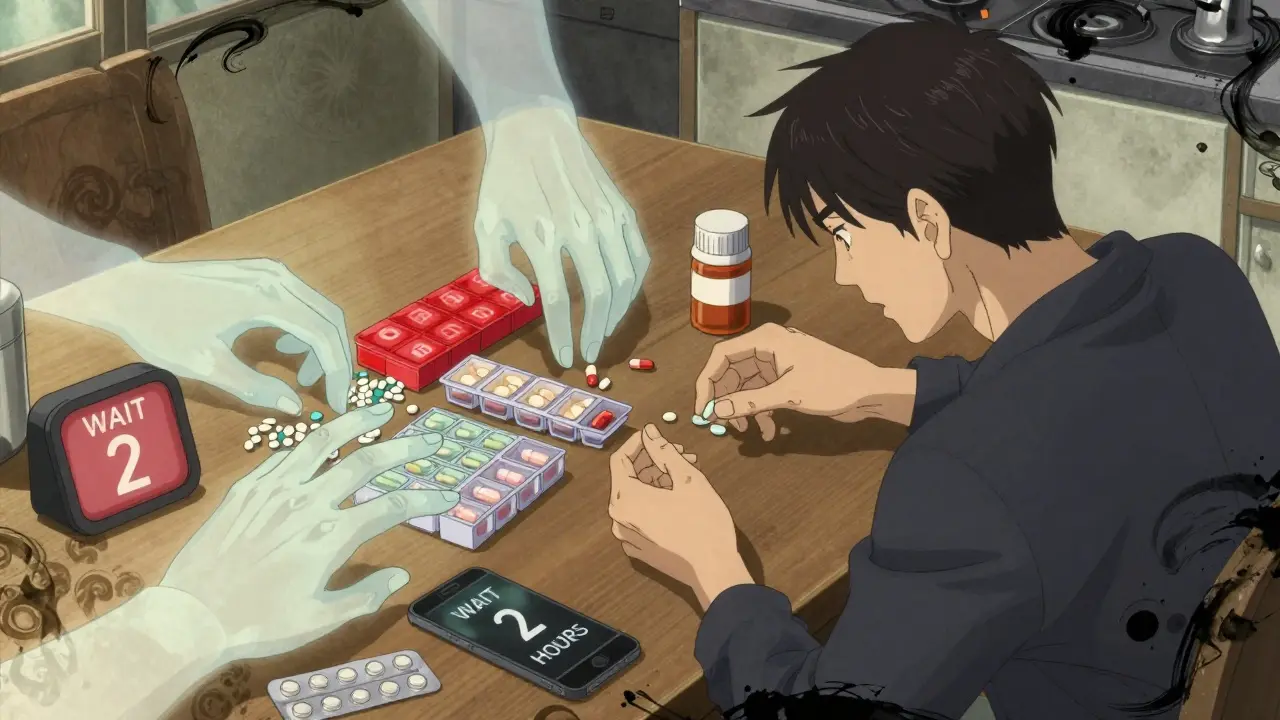
Real-Life Wins and Woes
In a geriatric clinic in California, pharmacists started separating iron supplements from proton pump inhibitors. After 18 months, iron deficiency anemia cases dropped by 32%. Patients didn’t need transfusions. Their energy came back. All because they stopped taking iron with their heartburn pill. But it’s not always smooth. One nurse in Florida tracked 120 elderly patients on 8-10 medications each. Half of them couldn’t follow the timing schedule. Why? Too many pills. Too many rules. “I forgot which one I had to wait for,” said one 78-year-old. “I just took them all together to be done with it.” That’s the problem. Timing sounds easy until you’re juggling five pills at breakfast, three at lunch, and four at night. And if your doctor, pharmacist, and nurse all give you different instructions? You’re lost.How to Get It Right
You don’t need to be a pharmacist to manage timing. Here’s how to make it work:- Make a full list of everything you take. Include vitamins, herbs, and over-the-counter meds. Don’t leave anything out.
- Ask your pharmacist to check for time-dependent interactions. Most have access to Lexicomp or Micromedex databases that flag TDDIs. Don’t assume your doctor caught them all.
- Use a pill organizer with separate compartments. A 7-day box with morning, afternoon, evening, and bedtime slots cuts timing errors by 43%. You can buy them for under $10 at any pharmacy.
- Set phone alarms. Use apps like Medisafe or MyTherapy. They’ll remind you when to take each pill - and when to wait. In one study, patients using these apps improved timing adherence by 57%.
- Write it down. If you’re on a complex schedule, make a simple chart: “Take levothyroxine at 7 a.m. - wait 4 hours before calcium.” Tape it to your bathroom mirror.

What’s Changing in 2026
Hospitals have been using computer systems to flag timing risks for years. Now, it’s getting smarter. New systems like Epic’s 2023 update use AI to adjust timing recommendations based on your kidney function, age, and even your stomach acid levels. If you’re older and your body processes drugs slower, the system might suggest a longer gap. The FDA is also pushing drug makers to include timing instructions on labels. More than 17 high-risk combinations now come with official separation guidelines - like clarithromycin and colchicine. Before, you had to dig through research papers. Now, it’s right on the bottle. But the biggest gap? Communication. Only 28% of outpatient clinics document timing instructions clearly in patient records. That means if you see a new doctor, they might not know you’re supposed to wait 4 hours between your thyroid pill and your iron.When to Call Your Doctor
You don’t have to figure this out alone. Call your provider if:- You’re taking 5 or more medications daily.
- You’ve had a recent change in energy, mood, or symptoms after starting a new drug.
- You’re confused about when to take your pills.
- You’ve missed a dose because you didn’t know you had to wait.
Final Thought: Small Changes, Big Results
You don’t need to overhaul your life. Just add a few minutes. Wait 30 minutes after your thyroid pill. Wait 2 hours after your antacid. Use your phone alarm. Write it down. These aren’t fancy tricks - they’re basic safety habits. Every year, over 100,000 Americans are hospitalized because of drug interactions that could’ve been avoided with timing. You don’t have to be one of them. It’s not about taking more pills. It’s about taking them right.Can I take my vitamins with my prescription meds?
Some vitamins can interfere. Calcium, iron, and magnesium are the biggest culprits. They can block absorption of antibiotics, thyroid meds, and osteoporosis drugs. Wait at least 2-4 hours between these and your prescriptions. Multivitamins with iron or calcium should be taken separately - not at the same time as your main meds.
What if I forget and take two meds together?
Don’t panic. Skip the next dose if it’s too close to the time you took them together - but only if your doctor says it’s safe. For example, if you took levothyroxine with calcium, don’t double up later. Just wait until your next scheduled dose. If you’re unsure, call your pharmacist. Never guess. Most interactions aren’t emergencies, but repeated mistakes can reduce your medication’s effectiveness over time.
Does coffee affect medication timing?
Yes - especially with thyroid medication. Coffee can reduce levothyroxine absorption by up to 55%. Wait at least 60 minutes after taking your thyroid pill before drinking coffee. For other drugs, coffee usually isn’t a problem unless you’re on certain antibiotics or psychiatric meds. Always check with your pharmacist if you’re unsure.
Are over-the-counter drugs safe to mix with prescriptions?
No. Antacids, pain relievers like ibuprofen, and even cold medicines can interact. For example, ibuprofen can increase bleeding risk if you’re on warfarin. Antacids can block antibiotics. Always ask your pharmacist before adding any OTC product to your routine - even if it’s labeled “natural” or “gentle.”
How do I know if a timing issue is causing my side effects?
Track your symptoms. If you feel worse after starting a new med - especially fatigue, nausea, dizziness, or lack of improvement - check your timing. Did you take your iron with your thyroid pill? Did you take your antibiotic with milk? Write down what you took and when. Bring this log to your pharmacist. They can spot patterns you might miss.
Neil Thorogood
January 24, 2026 AT 21:52So let me get this straight… I’m supposed to be a human pharmacy clock now? 😅 I take my thyroid pill at 7 a.m., wait 4 hours for calcium, 2 hours for antacids, 60 minutes for coffee, and still pray my statin doesn’t explode because I drank grapefruit juice yesterday? 🤯 I’m not a patient-I’m a time-management ninja with a pill organizer and a panic attack.
But hey, at least I’m not in the hospital. So… congrats? 🎉
Jessica Knuteson
January 25, 2026 AT 12:32Timing is a construct. The body doesn’t care about your alarm. The drugs don’t care about your schedule. You’re just organizing chaos with a spreadsheet.
Pharmacology is entropy. You think you’re controlling it. You’re not.
Stop pretending precision matters when biology is messy.
Take your pills. Live. Die. Either way it’s the same outcome.
Robin Van Emous
January 25, 2026 AT 18:56I really appreciate this breakdown. It’s easy to feel overwhelmed when you’re on a bunch of meds, but breaking it down into simple, doable steps makes it feel possible.
I’ve got my mom on a similar schedule-she’s 82 and takes 11 pills a day. We made a color-coded chart with big letters and taped it to her fridge. She says it’s the first time in years she hasn’t felt like a walking pharmacy.
Also, pill organizers are a miracle. I bought one for $8 at CVS and it’s changed everything. No more guessing. No more guilt.
Thank you for writing this. People like you make healthcare feel human.
Angie Thompson
January 26, 2026 AT 00:54OMG YES. I used to take my iron with my thyroid pill like a total idiot 🙈 Then I started feeling like a zombie who forgot how to be awake.
After I started waiting 4 hours? I had energy to clean my apartment. I smiled at strangers. I even watered my plants (RIP, but they’re alive now).
Also-coffee after thyroid? NON-NEGOTIABLE. I wait 60 minutes like it’s a sacred ritual. My thyroid is now my spirit animal. ☕️❤️
PS: My pharmacist gave me a free sticker that says ‘I waited for my meds’ and I put it on my water bottle. I’m not sorry.
Geoff Miskinis
January 26, 2026 AT 17:27Let’s be honest-this is basic pharmacokinetics 101. The fact that the general public needs a 2,000-word guide to understand absorption kinetics suggests a systemic failure in medical education.
And yet, here we are. People taking calcium with antibiotics like it’s a smoothie recipe. The real tragedy isn’t the interaction-it’s the collective ignorance that treats medicine like cereal.
Also, ‘set phone alarms’? That’s your solution? How quaint. I suppose next you’ll recommend tying a string around your finger.
Betty Bomber
January 27, 2026 AT 22:56I used to take everything together just to get it over with. Then I got dizzy for a week and my doctor asked if I’d been reading Reddit.
Turns out, I had.
Now I use Medisafe. It yells at me. I love it. I’ve only missed one dose in 6 months. Progress, not perfection.
Also, my cat now sits by my pill organizer like she’s my pharmacist. She judges me. I respect that.
Mohammed Rizvi
January 29, 2026 AT 09:20Back home in India, we just take our pills with chai and hope for the best. But honestly? This post made me rethink everything.
I take metformin, blood pressure meds, and turmeric capsules-all at breakfast. Now I’m wondering if my ‘natural’ remedies are just making my body confused.
Going to talk to my pharmacist tomorrow. Maybe I’ll start with just one gap. One step at a time.
Thanks for not talking down to us. That’s rare.
eric fert
January 29, 2026 AT 19:34Let me just say this: the entire premise of this article is a capitalist scam disguised as medical advice.
You’re not ‘preventing interactions’-you’re creating an entire industry around making people feel guilty for being human. Why do we need a $10 pill organizer? Why can’t drug companies just make pills that don’t fight each other? Why is the burden always on the patient?
And let’s not pretend that ‘timing’ is a universal solution. What about the homeless? The elderly with dementia? The single parent working two jobs who can’t remember if it’s 7 a.m. or 8 a.m.? This isn’t healthcare-it’s performative wellness for people who can afford to be punctual.
Meanwhile, Big Pharma is laughing all the way to the bank, selling you more pills, more organizers, more apps, more anxiety.
Fix the system. Not the patient.
Also, I take my thyroid pill with coffee. And I’m fine. So there.
And yes, I know this is long. But someone has to say it.