
EU Generic Drug Regulations: A Guide to Approval Pathways and 2025 Reforms

Trying to launch a generic drug in Europe feels like solving a puzzle where the pieces keep changing. One day you're dealing with a centralized agency in Amsterdam, and the next, you're navigating the specific stability data requirements of a regulator in Germany. With the European generic markets undergoing their biggest shake-up in twenty years via the 2025 Pharma Package, the stakes for getting your regulatory strategy right have never been higher.
The core goal of the EU's system is simple: keep patients safe while making medicine affordable through competition. It works, but it's messy. While generics make up about 65% of all prescriptions in the EU by volume, they only bring in 18% of the value. The real headache for manufacturers isn't just the science-it's the fragmentation. On average, it takes about 11.3 months longer for a generic to hit the market in some EU states compared to others, even after technical approval.
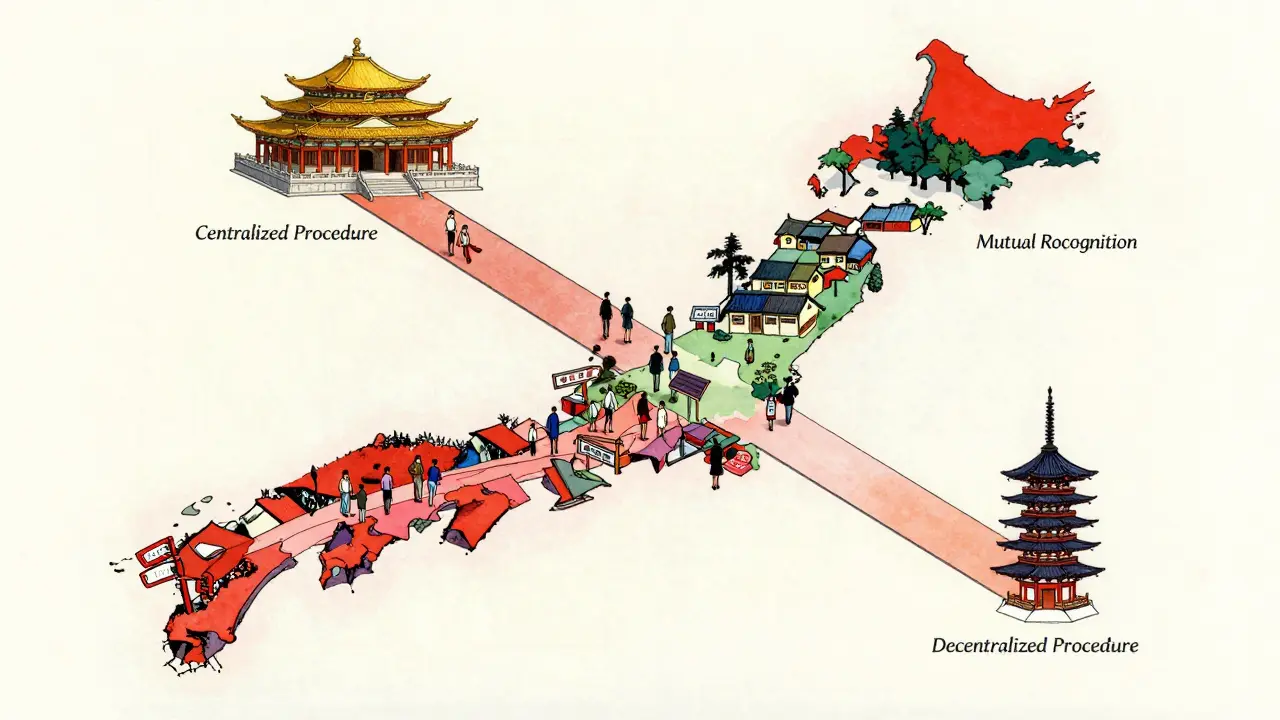
The Four Paths to Market Approval
Depending on your budget and where you want to sell, you have four main ways to get your drug approved. You can't just pick one at random; the choice depends on your projected sales and how much risk you can stomach.
Centralized Procedure (CP) is a single application process managed by the European Medicines Agency (EMA) that grants a marketing authorization valid across all 27 EU member states. It's the "gold standard" for high-value drugs. If you're expecting annual sales over €250 million, this is your route. The 2025 reforms have trimmed the timeline, with scientific assessments now aiming for 180 days. While it's the fastest way to hit every market at once, it's expensive. You're looking at application fees around €425,000, plus significant consultancy costs.
Mutual Recognition Procedure (MRP) is a process where a drug already approved in one EU country (the Reference Member State) seeks approval in other member states based on that initial authorization. This is a popular middle-ground, used in about 42% of generic applications. However, it's prone to "domino delays." For example, Teva found that pricing fights in Germany delayed their generic rosuvastatin launch in the Netherlands and Belgium by over eight months, despite the drug being technically approved.
Decentralized Procedure (DCP) is a pathway that allows simultaneous submission to multiple EU countries without needing a prior national authorization. On paper, it sounds great. In reality, it's often a nightmare. About 37% of DCP applications face delays of six months or more because different countries interpret quality requirements differently, especially in Eastern Europe.
National Procedure is the process of applying for authorization within a single member state's jurisdiction, limiting sales to that specific country. This is rarely used now (only 5% of cases) unless you're targeting one specific, high-reimbursement market. It's slow and doesn't leverage any of the EU's harmonization efforts.
| Pathway | Scope | Avg. Timeline | Est. Initial Cost | Best For... |
|---|---|---|---|---|
| Centralized (CP) | All EU States | ~226 Days | High (€1.6M+) | Blockbuster Generics |
| Mutual Recognition (MRP) | Selected States | ~133 Days | Medium (€200k) | Sequential Entry |
| Decentralized (DCP) | Selected States | ~247 Days | Medium | Simultaneous Multi-Market |
| National | One State | ~210 Days | Low | Niche/Small Markets |
The 2025 Pharma Package: What Actually Changed?
If you're still operating on 2020 rules, you're already behind. The reforms finalized on June 4, 2025, aren't just bureaucratic tweaks; they fundamentally change when you can enter the market.
The most exciting change for generics is the expanded Bolar exemption. This is essentially a legal "hall pass" that lets generic companies perform tests and prepare for launch while the original patent is still active. Previously, you could only start pricing and reimbursement talks two months before the patent expired. Now, that window has opened to six months. According to REMAP Consulting, this could shave about 4.3 months off the time it takes to get a product on shelves and could drop launch prices by 12-18% because payers have more leverage earlier.
Then there's the shift in Regulatory Data Protection (RDP). The standard protection has moved to a "8+1" year model. That's 8 years of data protection and 1 year of market protection. This means generic firms can potentially enter the market sooner, which is a huge win for 78 high-value biologics currently in the pipeline. However, the "obligation to supply" mechanism is a double-edged sword. While it's meant to stop medicine shortages, some experts worry that national authorities will define "sufficient quantities" differently, creating artificial bottlenecks in smaller markets.
Practical Hurdles: Bioequivalence and Bureaucracy
Getting the paperwork right is one thing; meeting the technical standards is another. To get approved, your drug must be a mirror image of the reference product. You have to prove it has the same qualitative and quantitative composition and a pharmaceutical form that behaves the same way in the body. This is called bioequivalence.
The EMA requires that the 90% confidence intervals for Cmax (peak concentration) and AUC (total exposure) fall between 80.00% and 125.00%. Sounds straightforward, but in practice, it's a minefield. A 2025 ABPI survey found that 68% of generic firms struggle with inconsistent national requirements. For example, if you're making a complex generic like an inhaler, Germany's BfArM often demands extra pharmacodynamic studies that the EMA doesn't even ask for.
You also need to prepare for the digital shift. By 2026, all product information must be submitted as electronic product information (ePI) in XML format. For many mid-sized firms, this means spending an extra €180,000 to €250,000 just on IT infrastructure to stay compliant.

The Global Competitive Landscape
The EU isn't operating in a vacuum. There is a massive push to close the gap between US and EU launch dates. Currently, generics launch about 22.4 months later in the EU than in the US. To fight this, the EU is streamlining, but the competition is heating up. Indian manufacturers are becoming a powerhouse, capturing 38% of all EU generic approvals in 2024, up from 29% just four years ago.
Meanwhile, the Critical Medicines Act of March 2025 has added another layer of complexity. It requires mandatory stockpiling for 200 essential generics. While this prevents the "empty shelf" syndrome that plagued the pandemic years, it adds new quality verification protocols that can act as a barrier to entry for smaller players who can't afford the extra overhead.
Strategic Tips for Generic Manufacturers
If you're planning a launch for 2026 and beyond, don't just follow the manual-think strategically about your pathway and timing.
- Audit your bioequivalence data early: If you're targeting Germany, don't just meet EMA standards. Check for polymorphic compound requirements and stability data specific to the German market.
- Leverage the 6-month Bolar window: Start your Health Technology Assessment (HTA) submissions and payer negotiations as soon as the six-month window opens. Waiting until the patent expires is a recipe for losing market share.
- Choose CP for high-margin products: As Sandoz proved with its version of Cosentyx, the Centralized Procedure can be 11 months faster than the MRP. If the profit margin justifies the €1.6M+ cost, the speed-to-market is worth every penny.
- Plan for XML transition: Don't leave your ePI infrastructure for the last minute. The 2026 deadline is a hard stop, and the technical hurdles with XML formatting are often underestimated.
What is the biggest change in the 2025 Pharma Package for generics?
The most significant changes are the expansion of the Bolar exemption (allowing pricing talks 6 months before patent expiry) and the reduction of standard Regulatory Data Protection to a "8+1" year model, which generally accelerates the timeline for generic entry.
Why is the Decentralized Procedure (DCP) considered risky?
DCP is risky because it relies on multiple national authorities agreeing on the same assessment simultaneously. If one country objects to a specific quality requirement, the entire clock can restart, leading to unpredictable delays-often exceeding six months.
How do I prove bioequivalence in the EU?
You must demonstrate that your generic drug has the same active substances and pharmaceutical form as the reference product. Technically, the 90% confidence intervals for the peak concentration (Cmax) and total exposure (AUC) must fall within the 80.00-125.00% range relative to the original drug.
Will the 2025 reforms reduce drug shortages?
Yes, through the new "obligation to supply" mechanism and the Critical Medicines Act's mandatory stockpiling for 200 essential generics. Some estimates suggest shortages could drop by 35% by 2028.
What happens if I only use the National Procedure?
Your marketing authorization will only be valid in that specific country. While this is cheaper and simpler for one market, you lose the ability to scale across the EU without starting the process over for every other member state.
Sakshi Mahant
April 4, 2026 AT 14:10It's really heartening to see the growth of Indian manufacturers in the EU market. We've always aimed to provide affordable healthcare globally, and seeing that 38% figure shows the hard work our industry is putting in to meet those strict EMA standards.
HARSH GUSANI
April 4, 2026 AT 14:42India is absolutely dominating the game now! 🇮🇳 EU is just trying to keep up with our efficiency. Who needs their slow bureaucracy when we can do it better and faster? Total win for us! 🚀💪
Rob Newton
April 4, 2026 AT 15:01CP is a racket. Just a way for the EMA to shake down companies for millions while pretending to streamline things.
The Charlotte Moms Blog
April 6, 2026 AT 11:53The XML transition costs are absolutely ridiculous!!! Who is actually auditing these figures??? €250k for a formatting change is a total scam... total scam!!!
Aysha Hind
April 7, 2026 AT 13:47Typical bureaucratic smoke and mirrors. They talk about "patient safety" but it's really just a way for Big Pharma to keep their stranglehold on the market through these convoluted "pathways." This whole 2025 package smells like a backroom deal to keep the elite in power while the little guys get crushed by XML fees. It's all a game to keep us dependent on their patented poison while they play with the timelines like it's a game of Monopoly. The "obligation to supply" is just a fancy word for state-mandated corporate control over what we're allowed to put in our bodies. Absolute madness that anyone falls for this streamlined nonsense. It's a web of lies designed to confuse the common man. The real goal isn't affordability, it's total surveillance of the supply chain. They want to know every single pill that moves across the border. Wake up people, this isn't about health, it's about a digital ledger of our biological needs. The Bolar exemption is just a crumb they throw to the generics to keep them from revolting. It's a calculated move to maintain the status quo while pretending to innovate. Pure, unadulterated corporate theatre.
Lawrence Rimmer
April 8, 2026 AT 11:24The pursuit of bioequivalence is just a modern manifestation of the Sisyphus myth. We spend millions to create a mirror image of something already existing, essentially erasing the creator to celebrate the copy. It's a sterile existence.
Hudson Nascimento Santos
April 8, 2026 AT 23:50One wonders if the drive toward harmonization is actually eroding the local medical nuances that national procedures once protected. The efficiency of the CP might be a win for capital, but perhaps a loss for regional specificity.
Dipankar Das
April 10, 2026 AT 07:13The industry must embrace these reforms with utmost urgency! Any firm failing to implement the ePI XML infrastructure by 2026 is essentially committing corporate suicide. This is a mandatory evolution for survival!
sophia alex
April 11, 2026 AT 06:31Imagine thinking the EU is the place to be for pharma when the US is still the gold standard for innovation. 🙄 The EU's "reforms" are just them trying to play catch-up to American excellence. Get real! 💅✨
Hope Azzaratta-Rubyhawk
April 13, 2026 AT 01:37Generic manufacturers need to stop whining about the costs and start optimizing their HTA submissions immediately! The 6-month Bolar window is an incredible opportunity that requires aggressive execution!
Mark Zhang
April 13, 2026 AT 11:31It sounds like a lot of stress for the mid-sized firms, but the Bolar exemption really is a game changer for getting meds to people faster. If anyone is struggling with the XML transition, maybe some collaborative industry workshops could help ease the burden.