
How to Keep a Symptom Diary for Suspected Drug Reactions

When you start a new medication, it’s normal to wonder: is this feeling because of the drug, or is it something else? Maybe you’re dizzy after taking your blood pressure pill, or your skin broke out after starting a new antibiotic. These symptoms could be harmless side effects-or they could be early signs of something serious. The difference often comes down to one thing: documentation.
Keeping a symptom diary isn’t just for doctors or clinical trials. It’s a practical tool anyone can use to track what’s really happening in their body when a new drug enters the picture. And it works. Studies show that patients who log symptoms as they happen are 83% more likely to help their doctor identify a true drug reaction than those who try to remember what happened days later.
What Exactly Should You Write Down?
A good symptom diary doesn’t just say "I felt sick." It answers the key questions your doctor needs to know: When? How bad? What else was going on? According to the National Institute on Aging’s 2018 guidelines, there are nine essential pieces of information you need to capture every time:
- Date and time you took the medication (to the minute, if possible)
- Exact dosage and how you took it (pill, injection, cream?)
- All other medications you took that day-including vitamins, supplements, and over-the-counter painkillers
- What symptom you felt (e.g., "rash on left forearm," "tingling in fingers," "sudden nausea")
- When the symptom started after taking the drug (e.g., "12 minutes later")
- How long it lasted (e.g., "3 hours," "went away after resting")
- What was happening around you (e.g., "I was outside in 30°C heat," "I hadn’t slept in 24 hours")
- What you did to feel better (e.g., "took antihistamine," "drank water," "lay down")
- Did it go away? If so, when? If not, did it get worse?
For severity, use the Common Terminology Criteria for Adverse Events (CTCAE) scale. It’s simple: Grade 1 is mild (annoying but doesn’t interfere with daily life), Grade 2 is moderate (you can’t do normal activities), Grade 3 is severe (you need medical help), and Grade 4 is life-threatening. You don’t need to be a doctor to use this-just ask yourself: "Is this just uncomfortable, or is it stopping me from functioning?"
Why Timing Matters More Than You Think
Memory is unreliable. Two days after a reaction, you might swear the dizziness started right after you took the pill. But was it 15 minutes? 4 hours? A study from the NIH found that after 48 hours, people’s recall of symptom timing drops by over 60%. That’s why the guidelines say: document within 15 minutes of symptom onset.
For acute reactions-like swelling, trouble breathing, or a sudden rash-this is non-negotiable. Anaphylaxis can develop in under 10 minutes. If you don’t record exactly when it started, your doctor can’t tell if it’s linked to the drug or something else you ate or touched.
For ongoing symptoms-like fatigue, nausea, or headaches-log them at the same time every day. Set a phone alarm. Even if nothing seems off, write "no new symptoms." Consistency builds a pattern. And patterns are what doctors use to make decisions.
Paper vs. Apps: Which One Actually Works?
You can use a notebook. But most people quit within 72 hours. Why? Because it’s too easy to forget, lose, or get overwhelmed by the effort.
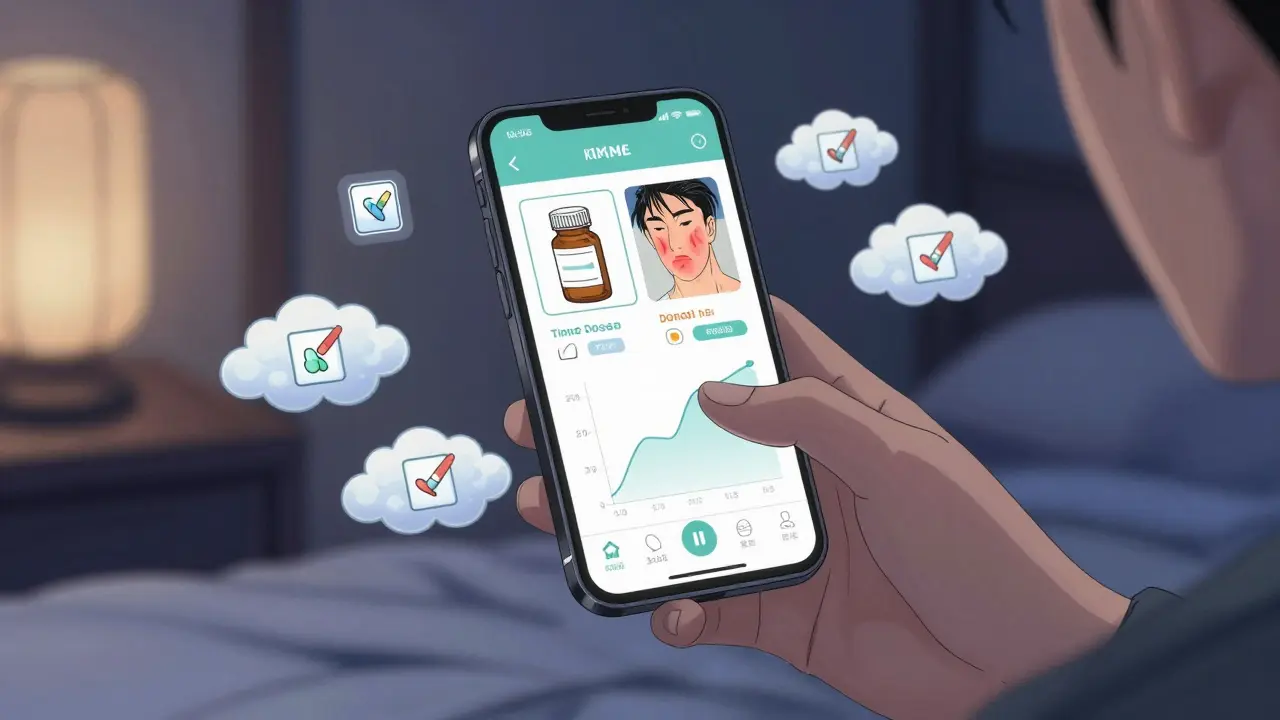
Apps like Medisafe, CareClinic, and MyTherapy fix this. They:
- Automatically timestamp every entry
- Send you reminders to log symptoms
- Generate charts showing when symptoms line up with doses
- Let you export a PDF to email to your doctor
Research from Scripps in 2023 found that only 22% of people using app-based diaries abandoned them within a week, compared to 57% using paper. The key? Automation. If you have to remember to write something down, you won’t. If your phone nudges you, you will.
One more thing: if you get a rash, take a photo. The European Medicines Agency found that visual evidence increased diagnostic accuracy by 78% for skin reactions. A blurry phone picture is better than a written description like "red spot on arm."
What Not to Document
Not every side effect needs to be logged. If you’re taking a statin and get mild muscle soreness-that’s common. If you’re taking a new antidepressant and suddenly can’t sleep for three nights straight? That’s worth tracking.
A 2022 study from the Institute for Safe Medication Practices found that 41% of diaries were overloaded with minor, expected side effects. This "noise" made it harder for doctors to spot the real problem. Focus on:
- Symptoms that are new since starting the drug
- Symptoms that are worse than before
- Symptoms that are unusual for you (e.g., you’ve never had rashes, now you have them)
- Symptoms that interfere with daily life
Don’t log every headache. Do log the headache that came with blurred vision and vomiting.
How to Make It Stick
Most people fail not because they don’t care-they’re just not set up to succeed. Here’s how to make this easy:
- Synchronize with your phone’s health app. If you log medication times in Apple Health or Google Fit, your symptom app can pull that data in automatically.
- Use checkboxes. Pre-printed forms with common symptoms (nausea, dizziness, rash, fatigue) cut logging time by half. You can find templates from the FDA or NIH websites.
- Review once a week. Every Sunday, spend 10 minutes looking over your entries. Do symptoms always happen after your 8 a.m. dose? Do they vanish after lunch? Write down your observations. Bring them to your next appointment.
- Ask your pharmacist. Many pharmacies now offer free 15-minute sessions to help patients set up symptom diaries. They’ve seen hundreds of cases and know what matters.
Real Stories, Real Results
One Reddit user, u/MedTracker89, shared how their neurologist dismissed their dizziness until they showed a 14-day diary. The diary proved the dizziness spiked exactly 20 minutes after each levodopa dose. The doctor changed the timing of the dose-and the dizziness vanished.
A 2023 survey of over 1,200 patients found that 42% had their medication adjusted based on their diary. Another 68% said their doctors listened more carefully when they brought data, not just complaints.
And it’s not just anecdotal. In clinical trials, patients using structured diaries reduced the need for unnecessary tests by 37%. That’s fewer blood draws, fewer scans, and faster answers.
What Happens If You Don’t Keep One?
Without a diary, you’re relying on memory. And memory is messy. A 2023 case study from Enjuris showed a patient involved in a car accident was wrongly blamed for impaired driving-when in fact, a newly prescribed painkiller caused dizziness. The patient had no record of when they took it or what they felt. The diagnosis took months. The patient lost their job.
That’s not rare. Incomplete or missing symptom logs are one of the top reasons drug reactions go undetected or misattributed.
When to Seek Help
Not every symptom needs a diary. But if you notice any of these, contact your doctor immediately:
- Swelling of the face, lips, or throat
- Difficulty breathing or wheezing
- Severe rash with blistering or peeling skin
- High fever with joint pain
- Sudden confusion, seizures, or loss of consciousness
These are red flags. Don’t wait to log them. Call your doctor or go to urgent care. Then, start the diary.
What if I forget to log a symptom?
If you miss a log, write it down as soon as you remember-but note the time you actually felt it, not the time you wrote it. For example: "Nausea at 3 p.m., logged at 8 p.m." It’s not perfect, but it’s better than nothing. Consistency matters more than perfection.
Do I need to log every single pill I take?
Yes. Even aspirin, melatonin, or herbal tea can interact with your new medication. Many reactions happen because of combinations, not single drugs. Write down everything you consume, even if it seems harmless.
Can I use a free app or do I need to pay for one?
Free apps like Medisafe and MyTherapy are fully capable. You don’t need to pay. Look for apps that let you export data as a PDF and have automatic timestamps. Avoid apps that require login or cloud syncing if you’re concerned about privacy.
How long should I keep the diary?
Keep it for at least two weeks after starting a new drug. For ongoing medications, keep it active as long as you’re on it. If you stop the drug and symptoms disappear, you can stop logging. But keep the record-you might need it later.
What if my doctor doesn’t care about the diary?
If your doctor dismisses your data, ask for a referral to a pharmacist or specialist. Pharmacists are trained in drug interactions and often value patient logs more than general practitioners. You have the right to advocate for your health. A symptom diary is your evidence-not just your opinion.
Erica Santos
March 10, 2026 AT 00:01Also, why does every article assume I have a smartphone, a stable internet connection, and zero mental health days? My 72-year-old mom can’t even open an app without crying. Paper diary? Sure. But who cares if she misses a log? She’s not dying because she forgot to write ‘nausea’ at 3:07 PM.
George Vou
March 10, 2026 AT 16:58also, i tried medisafe. it asked for my blood type. why? i dont even have a blood type. i'm a spirit.
Scott Easterling
March 12, 2026 AT 00:0890% of people who use these diaries? They’re not helping their doctor. They’re just trying to prove they’re ‘more disciplined’ than their spouse.
And don’t get me started on the ‘CTCAE scale’ - like, who the hell even uses this? Your doctor isn’t reading your Grade 2 fatigue log. They’re looking at your face and thinking, ‘She looks tired.’
Also, why are we assuming everyone has a phone? What about the people who still use landlines? Or the ones who live in rural areas where Wi-Fi is a myth?
And the photo thing? Yeah, great. Take a picture of your rash… then get charged $200 for a dermatology consult because ‘the image was unclear.’
Stop selling wellness porn. Most of us just want to not feel like crap. We don’t need a spreadsheet.
Mantooth Lehto
March 12, 2026 AT 11:52My doctor looked at it and said, 'Hmm, interesting.' Then she handed me a prescription for Xanax.
I cried. Not because I'm weak. But because I spent 14 hours documenting my life, and she saw a 'problem' instead of a person.
So now? I don't log. I just say, 'I feel like crap.' And guess what? She listens.
Emotional labor is not a medical protocol. 😭
Melba Miller
March 13, 2026 AT 09:28Do you have a smartphone? Good. Then you’re responsible for your own diagnosis.
Do you live in a trailer park with no cell service? Too bad. Your dizziness is ‘your fault.’
And don’t even get me started on the ‘export to PDF’ nonsense. You think your doctor wants a 12-page PDF? She wants a 30-second conversation.
Meanwhile, the pharmaceutical companies are laughing all the way to the bank - because if you’re busy logging your symptoms, you’re not suing them for side effects.
Smart. Real smart.
Katy Shamitz
March 14, 2026 AT 06:02But here’s the truth: most people don’t have the mental bandwidth to log symptoms while dealing with chronic pain, depression, or caregiving.
And yet, we’re told we’re ‘not trying hard enough’ if we don’t.
It’s not about discipline. It’s about access.
Why not just… trust patients? Why not train doctors to listen? Why must we become data-entry clerks just to be heard?
❤️ I just want to feel better. Not become a medical journalist.
Nicholas Gama
March 14, 2026 AT 21:29Automated timestamps? Please. Your phone logs your location, your heart rate, your sleep, your Spotify habits - now it’s logging your nausea?
Who owns this data? Who sells it?
And ‘export to PDF’? That’s not a feature - it’s a trap.
Real doctors don’t want PDFs. They want clinical intuition.
Stop pretending tech solves human biology.
Mary Beth Brook
March 16, 2026 AT 04:05Subjective descriptors like 'I felt bad' are clinically useless.
Objective quantification enables pharmacovigilance.
Without granular data, adverse event reporting devolves into anecdotal noise.
This isn’t wellness culture. It’s epidemiology.
Stop romanticizing memory. Your brain is a leaky bucket.
Neeti Rustagi
March 16, 2026 AT 22:25Philip Mattawashish
March 17, 2026 AT 01:44Every time you write ‘dizziness at 8:15 AM,’ you’re signing a contract with Big Pharma to be a data point.
They don’t care if you feel better. They care if your symptom pattern matches their clinical trial metrics.
And what happens when your diary says ‘no reaction’? You keep taking the drug.
What happens when it says ‘Grade 3’? They tell you to ‘monitor.’
You’re not documenting for your health. You’re documenting for their liability.
Wake up.
They want you to think you’re in control. You’re not.