
How to Store Prescription Labels and Leaflets for Future Reference
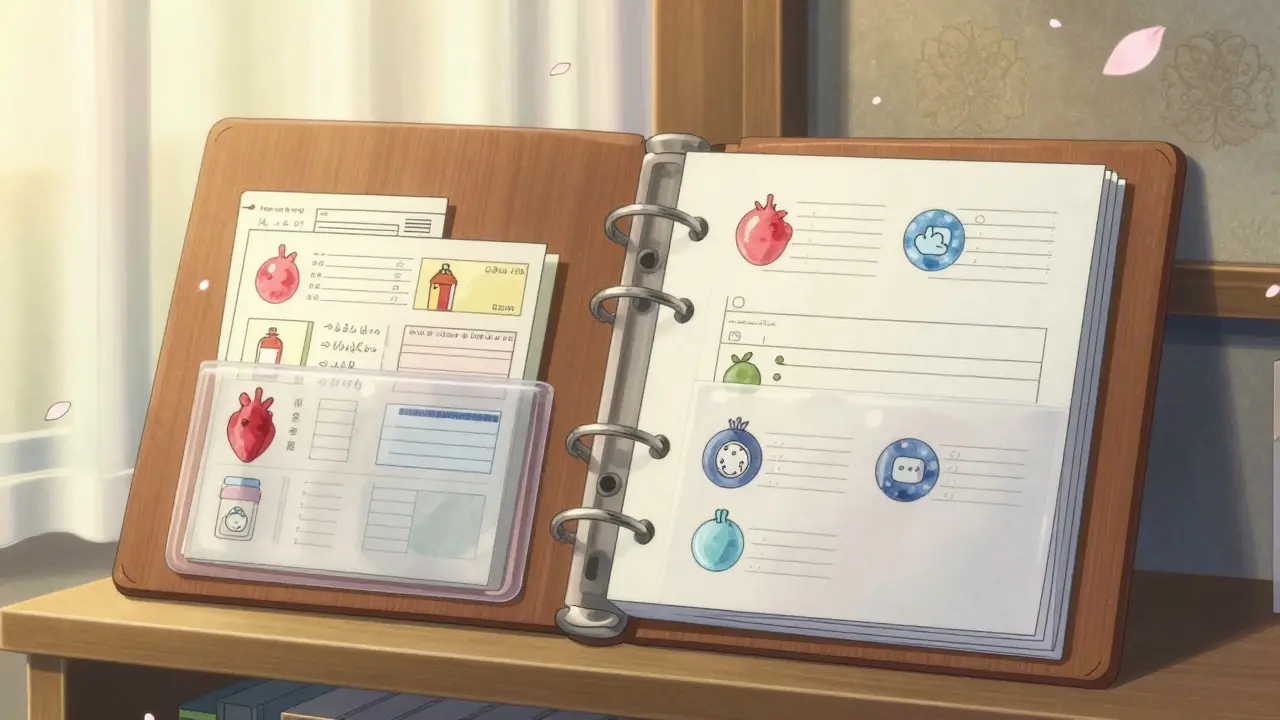
Keeping your prescription labels and medication leaflets isn’t just about being organized-it’s about safety. Every pill bottle you’ve ever taken has important details printed on it: your name, the drug name, the dose, when to take it, and when it expires. The leaflet inside? That’s where you find side effects, food interactions, and what to do if you miss a dose. Throw those away, and you’re guessing when you see a doctor, end up in the ER, or need to refill a long-term medication. Many people don’t realize that prescription labels are your personal medical history on paper-and losing them can cost you time, money, and even your health.
Why This Matters More Than You Think
In the U.S., medication errors cause around 7,000 deaths each year, according to the Institute of Medicine. A big part of that? Doctors not knowing what you’re really taking. You might think you remember your meds, but when you’re tired, stressed, or dealing with multiple conditions, memory fails. A 2022 study in the Journal of General Internal Medicine found that having organized records cuts adverse drug events by 55%. That’s not a small number. It means fewer hospital visits, fewer mistakes, and less stress for you and your family. Think about this: your doctor doesn’t have your full history unless you bring it. Electronic health records only keep data for 7 to 10 years. After that, they archive it. If you’ve been on the same blood pressure pill for 15 years, and you switch doctors, they won’t know unless you show them the label. Same goes for allergies or past reactions. That’s why keeping your labels isn’t optional-it’s essential.What Information Is Actually on a Prescription Label?
The FDA requires every prescription label to include 18-point bold text for key info. Here’s what you’re looking for:- Your full name
- Medication name (brand and generic)
- Dosage strength (like 10 mg or 500 mg)
- Instructions (e.g., “Take one tablet by mouth twice daily”)
- Prescriber’s name and contact info
- Pharmacy name and phone number
- Dispensing date
- Expiration date
- Refill amount
Physical Storage: The Simple, Reliable Way
If you prefer paper, you don’t need fancy tools. Start with a binder. Not just any binder-get one with clear plastic pockets. These are the same ones used for photo albums or school projects. Put each label and its matching leaflet into a separate pocket. Organize them alphabetically by medication name. It’s simple, fast, and doesn’t need electricity. Use color-coded tabs to group meds by type:- Red = Cardiovascular (blood pressure, cholesterol)
- Blue = Diabetes
- Green = Antibiotics
- Yellow = Pain/Inflammation
- Purple = Mental Health
Digital Storage: The Smart Backup
If you’re comfortable with apps, digital storage is powerful. Apps like MyMedSchedule (version 3.2.1, updated Jan 2024) let you take photos of your labels and leaflets. They store them securely in the cloud with end-to-end encryption. The app can even remind you when a med expires or when you’re due for a refill. Some even sync with your pharmacy’s system. But here’s the catch: not everyone can use them. A 2023 AARP survey found only 42% of adults over 65 feel confident using medication apps. If you’re not tech-savvy, it’s frustrating. And if your phone dies, or your internet goes out, you’re stuck. Also, privacy matters. Prescription data is 40 times more valuable on the black market than credit card info, according to IBM’s 2023 report. Only use HIPAA-compliant apps. Look for phrases like “encrypted cloud storage” or “secure patient portal.” Avoid random photo apps or Google Drive unless you know exactly how to lock them down.
The Best of Both Worlds: Hybrid System
The smartest approach? Combine physical and digital. Keep your current medications in a binder. That’s your go-to during emergencies. Scan or photograph older prescriptions-anything you haven’t taken in over a year-and upload them to a secure app. This keeps your binder from getting too bulky. For example: you’ve been on lisinopril for 12 years. You don’t need the 2015 label in your binder every day. But if you move to a new city and your doctor asks, “Have you ever had an allergic reaction to ACE inhibitors?” you can pull up the old label on your phone. The FDA is pushing this direction. Starting in 2024, all new prescription labels must include a QR code that links to digital info. That means you can scan a label with your phone and instantly get the full leaflet-even if you lost the paper copy. This is the future. But until then, don’t wait. Start now.Common Mistakes to Avoid
People make the same mistakes over and over:- Throwing out old pill bottles because they’re “empty.”
- Keeping labels in random drawers or boxes-they get mixed with receipts, junk mail, or old coupons.
- Only storing the label and ignoring the leaflet. That’s like keeping a car key but tossing the manual.
- Using sticky notes to rewrite instructions. You’ll forget what you wrote.
- Assuming your pharmacy will remember everything. They won’t. Pharmacies change owners, close, or lose records.
How Much Time Does It Take?
Setting up your system takes 15 to 20 minutes the first time. Once it’s done, adding new prescriptions takes 2 to 3 minutes per bottle. Just snap a photo or slip the label in. Do it right after you pick up your meds-before you forget. If you’ve been taking meds for years and have a pile of old bottles? Don’t panic. Start with your top five most important ones. Then work your way down. You don’t need to do it all at once.
What If You Can’t Afford a Binder or App?
You don’t need to spend money. A simple folder with paper clips works. File each label and leaflet together in a manila folder. Label the tabs with medication names. Keep it in a drawer. It’s low-tech, but it works. The American Society of Health-System Pharmacists says even basic organization reduces errors by 68%. Free resources are out there. The Institute for Safe Medication Practices offers a free printable guide called “Your Medication Record: A Patient’s Guide.” You can download and print it. Fill it out by hand. No app needed.What About Legal and Insurance Needs?
Some states, like California, require you to keep medication records for 10 years for legal reasons. Medicare and private insurers may ask for proof of long-term use if you’re applying for coverage or appealing a denied claim. If you’ve been on insulin for 8 years and your insurer says, “We don’t see prior use,” you need proof. That’s your label. In 2024, the Office of the National Coordinator for Health IT launched a program called “MyMedicationHistory” to let patients share their personal records with doctors through EHR systems. By 2026, this will be standard. But until then, you’re still the keeper of your own records.Final Tip: Make It a Habit
Treat your prescription labels like your passport or birth certificate. You don’t throw those away. You protect them. Set a reminder on your phone: “Every 3 months, check your binder. Add new meds. Toss expired ones.” You don’t need to be perfect. You just need to be consistent. One label saved. One leaflet kept. One less risk.Should I keep prescription labels even after the bottle is empty?
Yes. The label contains vital information like the medication name, dosage, and expiration date-even if the pills are gone. Doctors and pharmacists need this to understand your treatment history. Keep the label and leaflet together in your record system.
Can I just use my pharmacy’s app to store my meds?
Pharmacy apps are helpful for refills and reminders, but they’re not a substitute for your own records. Pharmacies can lose data, change systems, or shut down. Your personal record-whether digital or physical-is yours to control and access anytime, anywhere.
What if I can’t read the small print on the label?
Take a photo with your phone and zoom in. Most labels use 18-point bold font, so even a low-res photo is readable. You can also ask your pharmacist for a printed copy of the label. They’re required to provide it.
Do I need to keep leaflets for over-the-counter meds too?
Yes. Many OTC drugs interact with prescriptions. For example, ibuprofen can interfere with blood pressure meds. Keeping all medication leaflets-prescription and OTC-gives you a complete picture for your doctor.
How long should I keep old prescription records?
Keep records for at least 10 years, especially for chronic conditions like diabetes, heart disease, or mental health meds. Some states legally require 10-year retention. Even after that, keep anything related to allergies or serious side effects-it could save your life decades later.
Is it safe to store medication info on my phone?
Only if you use a HIPAA-compliant app with encryption. Avoid general photo albums or cloud storage without password protection. Prescription data is a high-value target for hackers. Use apps like MyMedSchedule, or lock your phone with a strong passcode and enable two-factor authentication.
Janette Martens
December 28, 2025 AT 16:04so i just threw out all my meds labels cuz i thought they were useless... now i feel like a dumbass. thanks for the wake-up call. my grandma died because they didn't know she was on warfarin and the doc gave her aspirin. RIP.
Marie-Pierre Gonzalez
December 29, 2025 AT 21:57Thank you for this profoundly thoughtful and meticulously researched guide. 🙏 I have been organizing my medications in a three-ring binder with acid-free sleeves since 2019, and I can confidently say it has saved me from three potential adverse drug events. I urge everyone to adopt this practice-not as a chore, but as an act of self-respect and dignity in healthcare.
Louis Paré
December 31, 2025 AT 04:19Wow. Another feel-good article from someone who clearly doesn't understand how the American healthcare system works. You think a binder is going to stop a pharmacist from misreading your script? Or a doctor from prescribing you something they haven't reviewed? This is performative organization. It looks good on Instagram. Doesn't fix the broken system.
Hakim Bachiri
December 31, 2025 AT 07:19OMG. I just realized I’ve been storing my pill bottles in a Tupperware container next to my laundry detergent. That’s not a system-that’s a biohazard zone. Also, why is everyone so obsessed with paper? I screenshot every label on my iPhone. Done. Cloud backup. Done. End of story. Why are we still using binders in 2024???
Celia McTighe
January 2, 2026 AT 03:01This made me cry 😭 I’ve been keeping my meds organized since my dad had a bad reaction to mixing his blood thinner with OTC painkillers… I never told anyone how scared I was. Thank you for validating this. I just scanned all my old labels into MyMedSchedule last week. It feels like I’m finally taking care of myself. 💙
Nicole Beasley
January 3, 2026 AT 04:24Wait-so if I take a photo of the label, is that legally valid? Or do I need the actual paper? Asking for a friend who’s terrified of getting sued because her mom’s label got wet in the shower.
Vu L
January 4, 2026 AT 14:31Why are we treating this like a survival guide? It's just pills. You don't need a binder. You don't need a QR code. Just don't mix your Adderall with your Xanax. That's the only rule you need.
James Hilton
January 5, 2026 AT 02:27Y’all are overcomplicating this. I keep my labels in a Ziploc in my wallet. If I collapse, the EMTs pull it out. Done. No binder. No app. Just a plastic bag. 🇺🇸
Mimi Bos
January 6, 2026 AT 23:29i just realized i’ve been keeping my leaflits in the same drawer as my expired coupons and old gym receipts… oops. 🤦♀️ also, why is everyone so into color coding? i just use post-its. it works. kinda. maybe.
Sydney Lee
January 8, 2026 AT 20:24Let me be the first to say this: the entire premise of this post is dangerously naive. You assume everyone has access to binders, scanners, smartphones, and stable internet. What about the elderly? The homeless? The undocumented? This isn’t ‘personal responsibility’-it’s a systemic failure disguised as a life hack. And you’re patting yourself on the back for doing the bare minimum while others are left to die because they can’t afford a $10 binder.
oluwarotimi w alaka
January 10, 2026 AT 15:25you think this is about meds? no. this is about control. they want you to track everything so they can track YOU. qr codes? cloud storage? they're building a digital fingerprint. next they'll force you to upload your blood pressure data to the feds. i'm burning my labels. freedom first.