
When Pharmacists Should Recommend Authorized Generics: A Practical Guide
When a patient walks into the pharmacy with a prescription for a brand-name drug, the pharmacist’s first thought isn’t always about cost-it’s about safety. And sometimes, the best option isn’t the cheapest generic. It’s the authorized generic.
What Exactly Is an Authorized Generic?
An authorized generic is the exact same medication as the brand-name drug, made by the same company, using the same ingredients, in the same factory. The only difference? It doesn’t have the brand name on the label. No logo. No fancy packaging. Just the active ingredient and the same inactive ingredients-fillers, dyes, coatings-that the brand uses. This isn’t your typical generic. Regular generics are approved through the FDA’s Abbreviated New Drug Application (ANDA) process. They must prove they’re bioequivalent to the brand. But authorized generics skip that step because they’re not just similar-they’re identical. The FDA defines them as listed drugs marketed under a different label, but with no changes to formulation. That means if your patient has been taking Brand X for years and suddenly switches to a regular generic, they might get a different filler-maybe gluten, lactose, or gelatin. But if they switch to the authorized generic? Nothing changes inside the pill.When to Recommend an Authorized Generic: Three Key Scenarios
Not every patient needs an authorized generic. But for some, it’s the only safe option.1. Patients with Allergies or Dietary Restrictions
Think about someone with celiac disease. They can’t tolerate gluten. A regular generic version of their medication might use wheat starch as a filler. The brand-name version? Gluten-free. The authorized generic? Also gluten-free-because it’s the same formula. Same goes for vegans avoiding gelatin capsules, or patients with lactose intolerance. Regular generics often change inactive ingredients to cut costs. Authorized generics don’t. If the brand works for a patient’s dietary needs, the authorized version will too.2. Narrow Therapeutic Index (NTI) Drugs
Some drugs have a razor-thin margin between effectiveness and toxicity. Warfarin, levothyroxine, phenytoin-these aren’t drugs you want to mess with. Studies show that switching from brand to regular generic for NTI drugs causes therapeutic problems in 3-5% of patients. Blood levels shift. Seizures return. Thyroid levels go haywire. Authorized generics eliminate that risk. Since they’re chemically identical to the brand, there’s no variation in absorption or release. For patients on these drugs, especially those who’ve had stability issues, the authorized generic is the safest substitution.3. Modified-Release Formulations
Extended-release tablets, delayed-release capsules, osmotic pumps-these complex delivery systems are hard to replicate perfectly. A regular generic might release the drug too fast or too slow, even if it passes bioequivalence testing. Authorized generics? Same manufacturing process. Same controlled-release mechanism. Same performance. For drugs like Adderall XR, OxyContin, or Topamax CR, the authorized version often delivers more consistent results than a standard generic.What About Cost?
Authorized generics usually cost 20-80% less than the brand-name version. That’s a huge savings. But here’s the catch: insurance doesn’t always treat them like generics. Many pharmacy benefit managers (PBMs) still classify authorized generics under brand-name tiers. That means a patient might pay $50 out-of-pocket for an authorized generic, even though it’s the same as a $10 generic. Why? Because the PBM’s contract with the brand manufacturer still applies. Pharmacists need to check the formulary before recommending. If the authorized generic is priced higher than the regular generic, it’s not always the best financial choice-unless the patient needs the identical formulation for medical reasons.
How to Spot an Authorized Generic
You can’t tell by looking at the pill. The color, shape, and markings are often different. A white brand-name tablet might become a blue authorized generic. That’s normal. But patients panic when their pill changes color. The real way to identify them? Check the National Drug Code (NDC). Authorized generics share the same active ingredient and strength as the brand-but the labeler code will match the brand manufacturer (like Pfizer or Merck) or an authorized partner (like Prasco or Greenstone). It won’t be a traditional generic maker like Teva or Mylan. The FDA updates its official list of authorized generics every quarter. As of September 2023, there were 257 authorized generics on the list-about 5% of all brand-name drugs with generic alternatives. Most are oral tablets or capsules.What to Tell Patients
Patients don’t understand why a pill looks different. They think it’s a different drug. That’s why counseling matters. Don’t just hand over the bottle. Say: “This is the same medicine you’ve been taking, just without the brand name. The ingredients are identical-same active drug, same fillers, same everything. It’s just cheaper.” Studies show that 27% of patients stop taking their medication when the pill looks different. But if you explain it clearly? That number drops to 8%. For patients with chronic conditions, this isn’t just about cost. It’s about trust. If they’ve had bad reactions to generics before, this is the version they can rely on.Legal and Documentation Rules
In 42 U.S. states, pharmacists can substitute a brand-name drug with an authorized generic without the prescriber’s permission-unless the script says “do not substitute.” But 18 states require you to notify the prescriber whenever you make any generic substitution, including authorized generics. Always check your state’s rules. Document everything. Use the “DA” modifier in billing systems to show a substitution occurred. Keep records showing the authorized generic matches the brand in active and inactive ingredients. If a patient has an adverse reaction, you’ll need proof you made a safe substitution.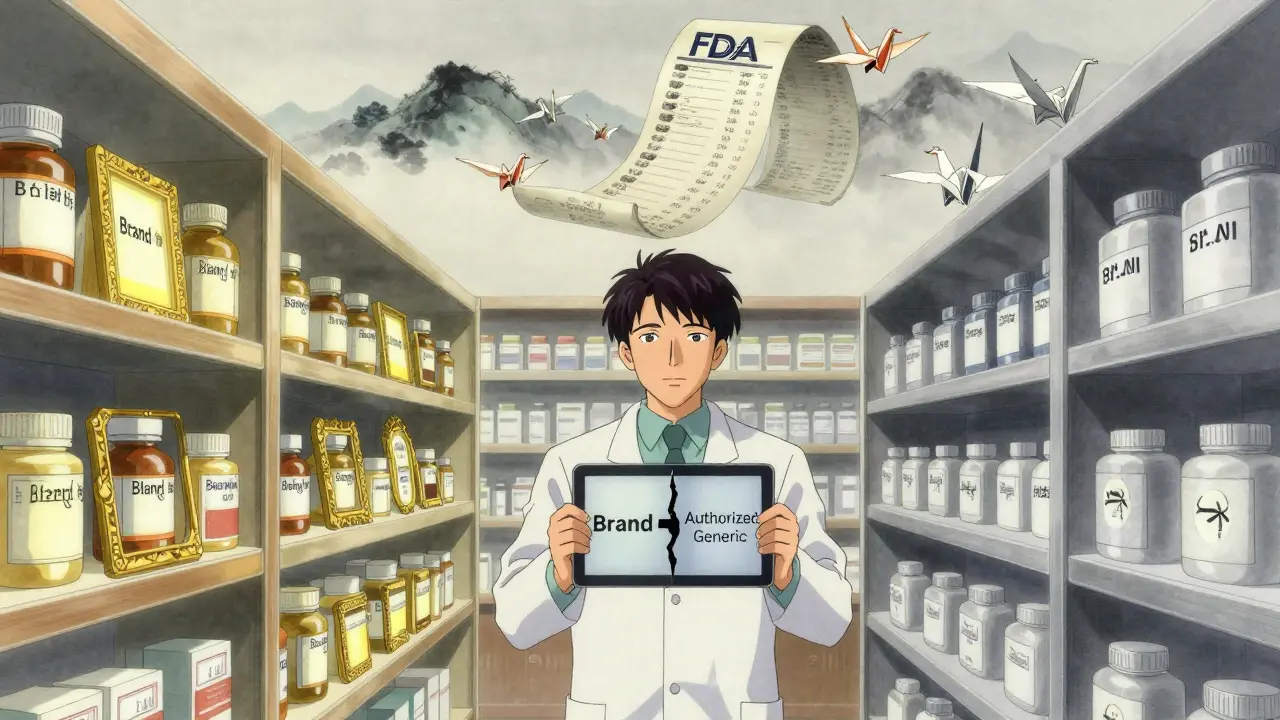
Limitations and What’s Not Covered
Not every brand has an authorized generic. Only 5% of brand-name drugs do. And while they’re identical to the brand, they’re not always cheaper than regular generics. Sometimes, a $5 generic is still the best option. Also, packaging changes can cause confusion. A bottle that used to say “Brand X 10mg” now says “Generic 10mg” with a different label. That’s fine-but patients need to know it’s the same. And while authorized generics are automatically considered therapeutically equivalent by the FDA, they don’t appear in the Orange Book. That’s a common point of confusion. Pharmacists need to rely on the FDA’s authorized generic list, not the Orange Book, to verify availability.The Future of Authorized Generics
Authorized generics are growing. From 2010 to 2019, their numbers increased by 18% per year. More manufacturers are launching them, especially after the first generic competitor enters the market. That’s no accident-it’s a strategy to compete on price without losing quality. Consumer awareness is rising too. Searches for “authorized generics” jumped 47% in one year. Patients are asking about them. And with new legislation like the Affordable Insulin Now Act, we may see more authorized generics for high-cost medications. Pharmacists who understand these drugs aren’t just filling prescriptions-they’re preventing medication errors, improving adherence, and saving lives.What to Do Next
- Check the FDA’s quarterly authorized generic list before filling any brand-name prescription. - Talk to your wholesaler. Some authorized generics are only available through certain distributors. - Train your staff. Make sure everyone knows how to identify and explain authorized generics. - Keep a reference sheet in the pharmacy: common brand names and their authorized generic equivalents. - When in doubt, call the prescriber. Better safe than sorry. Authorized generics aren’t a magic bullet. But for the right patient, at the right time, they’re the best choice you can make.Are authorized generics the same as brand-name drugs?
Yes. Authorized generics are manufactured by the same company that makes the brand-name drug, using the exact same active and inactive ingredients, in the same facility. The only differences are the label, packaging, and price-they’re chemically identical.
Why do authorized generics look different from the brand?
Manufacturers change the color, shape, or markings to distinguish the authorized generic from the branded version on the shelf. This avoids confusion and trademark issues. But the medicine inside is unchanged.
Are authorized generics cheaper than regular generics?
Usually not. Regular generics are typically 80-85% cheaper than the brand. Authorized generics are 20-80% cheaper than the brand, but often cost more than standard generics. Their value isn’t in price-it’s in identical formulation.
Can I substitute an authorized generic without the doctor’s permission?
In most states (42 out of 50), yes-unless the prescription says “do not substitute.” But 18 states require you to notify the prescriber. Always check your state’s pharmacy laws before substituting.
Why do some insurance plans charge more for authorized generics?
Many pharmacy benefit managers (PBMs) classify authorized generics under brand-name tiers in their formularies, even though the drug is identical. This is often due to contracts with brand manufacturers. Always verify the patient’s out-of-pocket cost before recommending.
How do I find out if an authorized generic exists for a brand drug?
Use the FDA’s quarterly updated list of authorized generics, available on their website. You can also check the NDC directory-the labeler code will match the brand manufacturer or an authorized licensee, not a typical generic company.
Do authorized generics work for all types of medications?
No. Only about 5% of brand-name drugs have authorized generic versions. They’re most common for oral tablets and capsules. Injectable drugs, inhalers, and complex biologics rarely have authorized generics due to manufacturing complexity.
William Liu
December 19, 2025 AT 11:41Just had a patient yesterday who switched from Brand X to the authorized generic and cried because she thought it was a different drug. Told her it’s the exact same pill, just no logo. She thanked me so hard I almost cried too. This stuff matters more than we realize.
Frank Drewery
December 21, 2025 AT 00:54I’ve been pushing authorized generics for years, especially for my elderly patients on warfarin. One guy had three INR spikes in six weeks after switching to a regular generic. Switched him to the authorized version? Stable as a rock. No drama. No hospital visits. Just good pharmacy practice.
Danielle Stewart
December 22, 2025 AT 07:49For patients with celiac or severe allergies, this isn’t just a cost-saving tip-it’s a safety net. I keep a printed list next to the counter: Brand X → Authorized Generic Y, gluten-free, same fillers. Patients see it, trust it, take it. Adherence jumped 40% in my shop since we started doing this. Small changes, huge impact.
mary lizardo
December 22, 2025 AT 16:09It is imperative to note that the FDA’s classification of authorized generics as therapeutically equivalent is not a legal mandate for substitution in all jurisdictions. Moreover, the assertion that they are "identical" is technically inaccurate-while the active ingredient and excipients are identical, the manufacturing process may differ in minor, non-validated ways, such as batch-to-batch variation in particle size distribution. This is not to say they are unsafe, but the language in this article is dangerously reductive. Pharmacists must exercise professional discretion, not blind adherence to marketing narratives.
jessica .
December 22, 2025 AT 16:36Authorized generics? Sounds like Big Pharma’s way to keep control while pretending to be cheap. The FDA is in bed with these companies. You think they really want you to save money? Nah. They want you to keep buying the same pill with a new label. And don’t get me started on how they hide the real ingredients in those "fillers"-they’re probably putting fluoride in there to control the population. Look up the NDC codes. They all trace back to the same few corporations. Wake up.
Ryan van Leent
December 24, 2025 AT 11:21Why do we even have to explain this to patients? It’s their job to trust the system. I’ve had people refuse meds because the pill was blue instead of white. Like it’s magic or something. And now we’re supposed to train staff and make reference sheets? Come on. Just fill the damn script. If they don’t like it, go to the doctor. Why is this my problem?
Sajith Shams
December 25, 2025 AT 10:44You Americans think you invented medicine. In India, we’ve been using generic drugs for decades. No one cares about authorized generics. We use whatever works. The brand-name drugs are overpriced nonsense. If the generic passes bioequivalence, it’s fine. Your obsession with inactive ingredients is ridiculous. Most people don’t even know what excipients are. Stop overcomplicating. Just give them the cheapest thing that works.
Adrienne Dagg
December 25, 2025 AT 19:11OMG YES THIS. I had a patient with a gelatin allergy and the regular generic had it in the capsule. I found the authorized version and she cried. 🥹 Thank you for writing this. I’m printing this out and taping it to the counter. Everyone needs to know this.